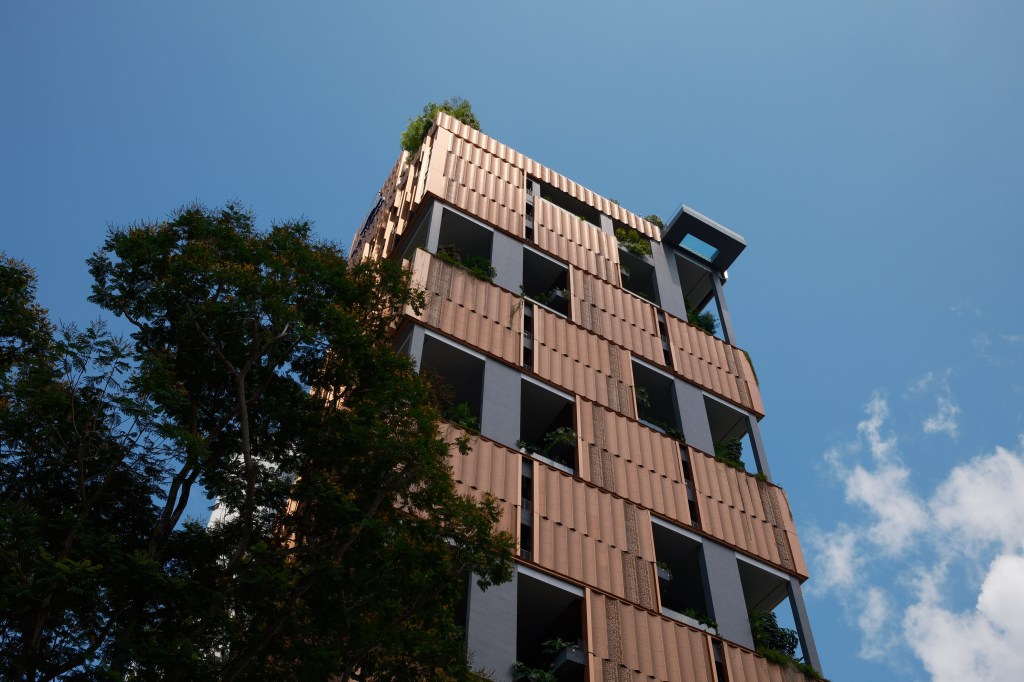
The Sigma BF—arguably the most minimalist camera of our time—has officially launched in Singapore. I’m grateful to have been invited by Mr. Lawson from Sigma Marketing (Singapore) to attend the launch event, which took place at Artizen Singapore. While the venue was more compact than I had anticipated, it turned out to be a cosy and thoughtfully arranged space.
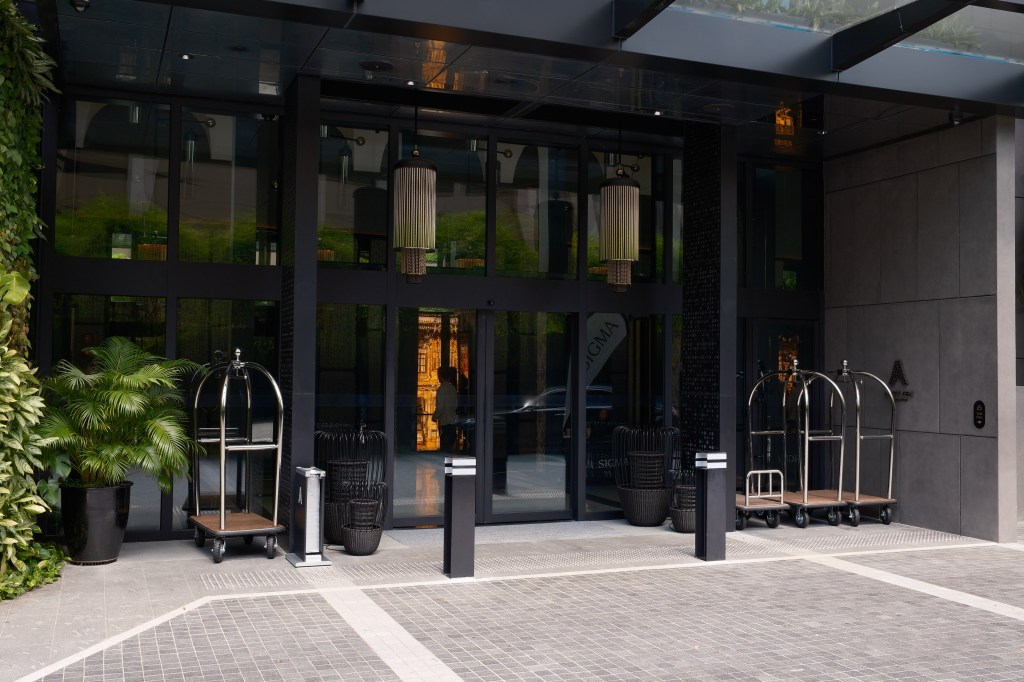
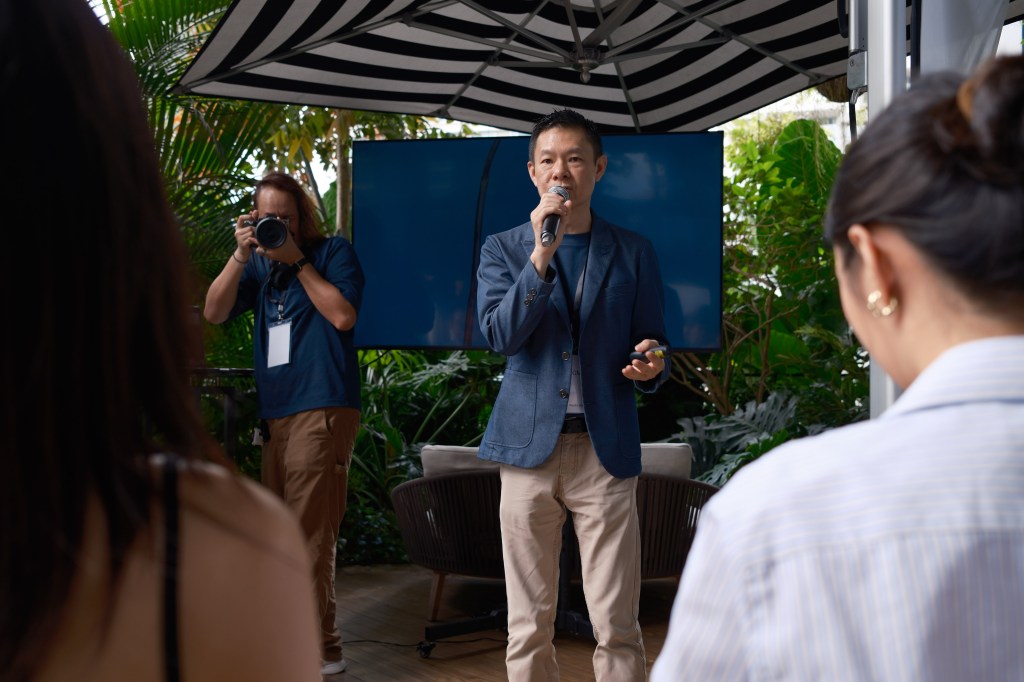
Artizen SingaporeArtizen Singapore EntranceSigma BF launch bannersThe balcony space for Sigma BF launch Left: Mr. Bobbi Tonelli, the host of the event, also shared his experience about the Sigma BF. Right: The Sigma ambassador from Malaysia, Mr Wesly Wong, explaining the philosophy behind the design of Sigma BF
Sigma BF Silver
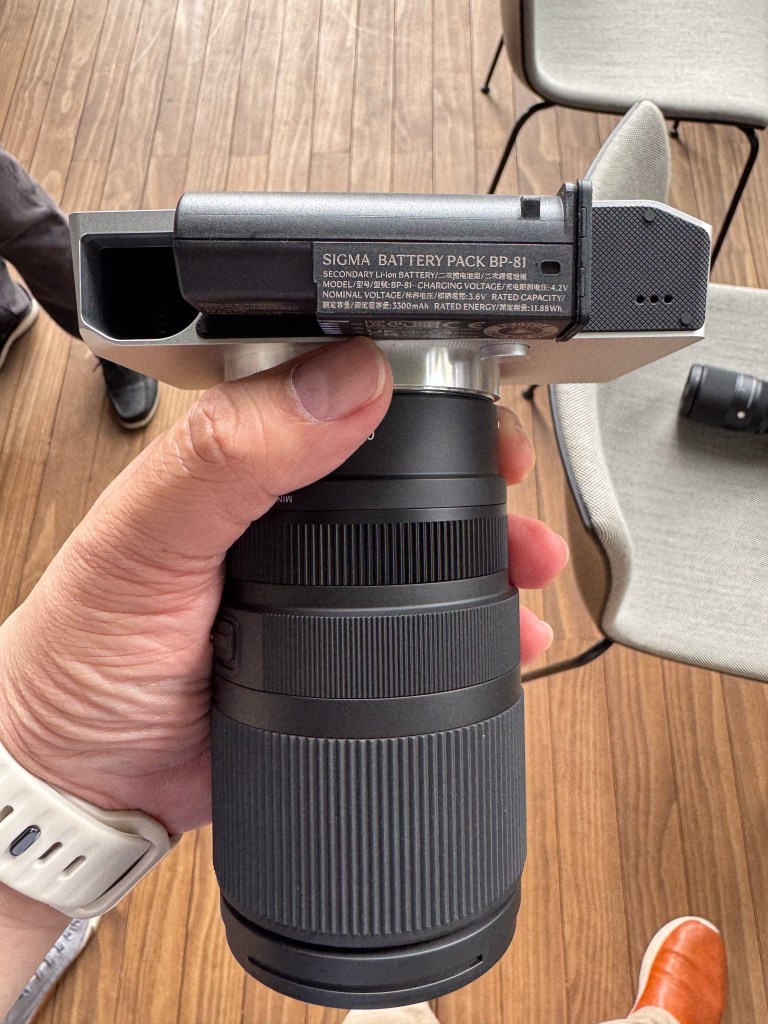
Comes with a replaceable battery pack.
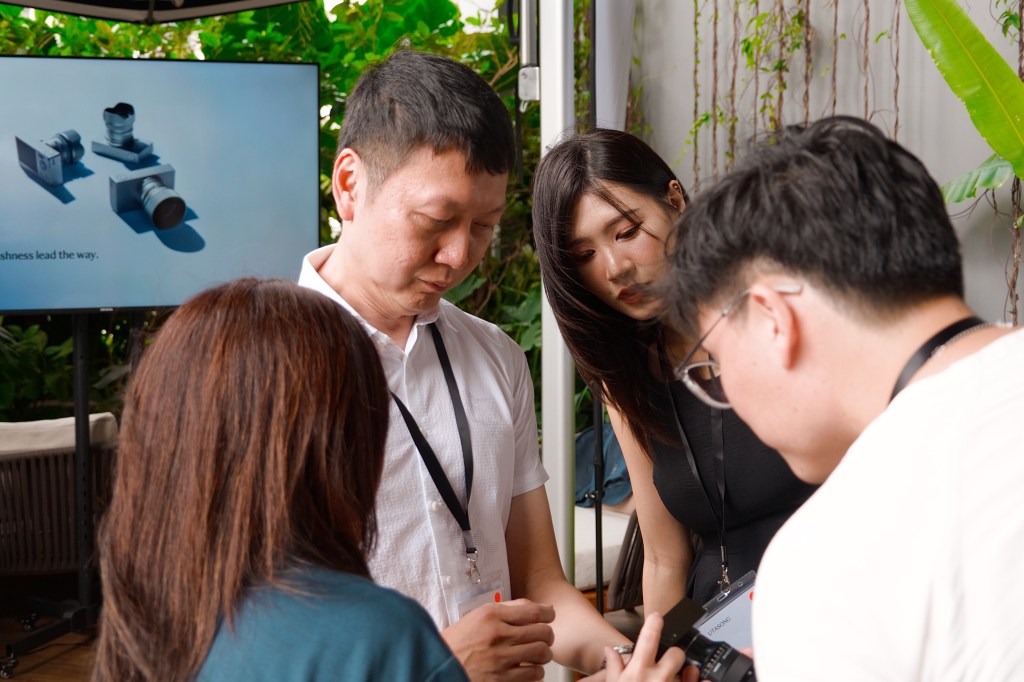
Following the opening segment, we were grouped into small teams of three, each guided by a Sigma staff member, and began exploring the charm of this unique camera. The user interface—distinctly different from the conventional design—caught my attention right away. Surprisingly, it took me less than five minutes to get the hang of it and feel completely comfortable using it. It’s impressively intuitive.
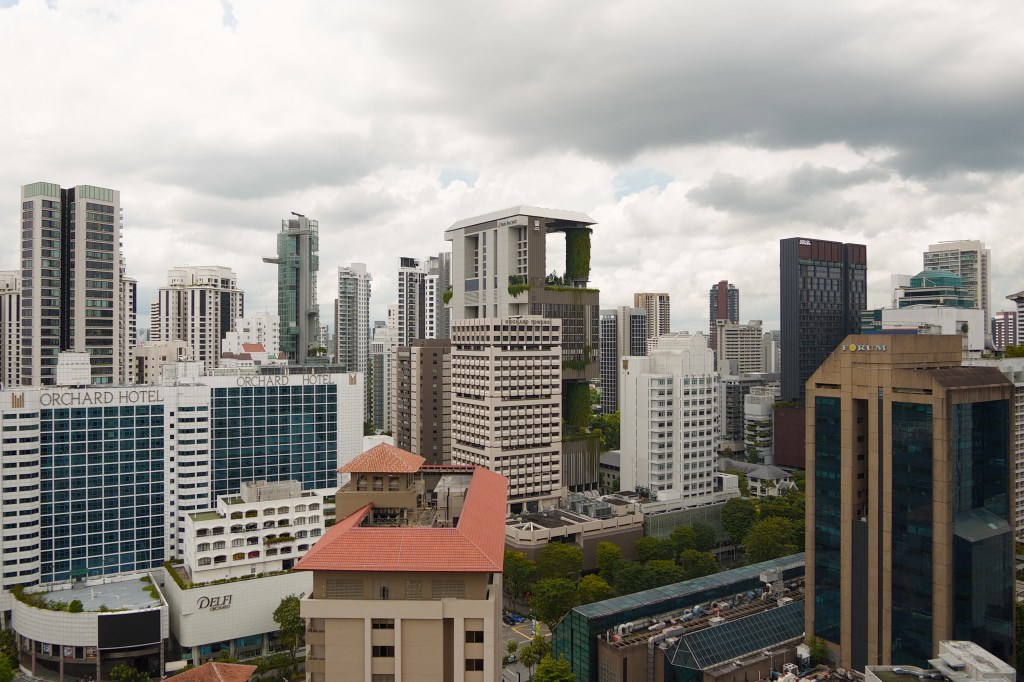
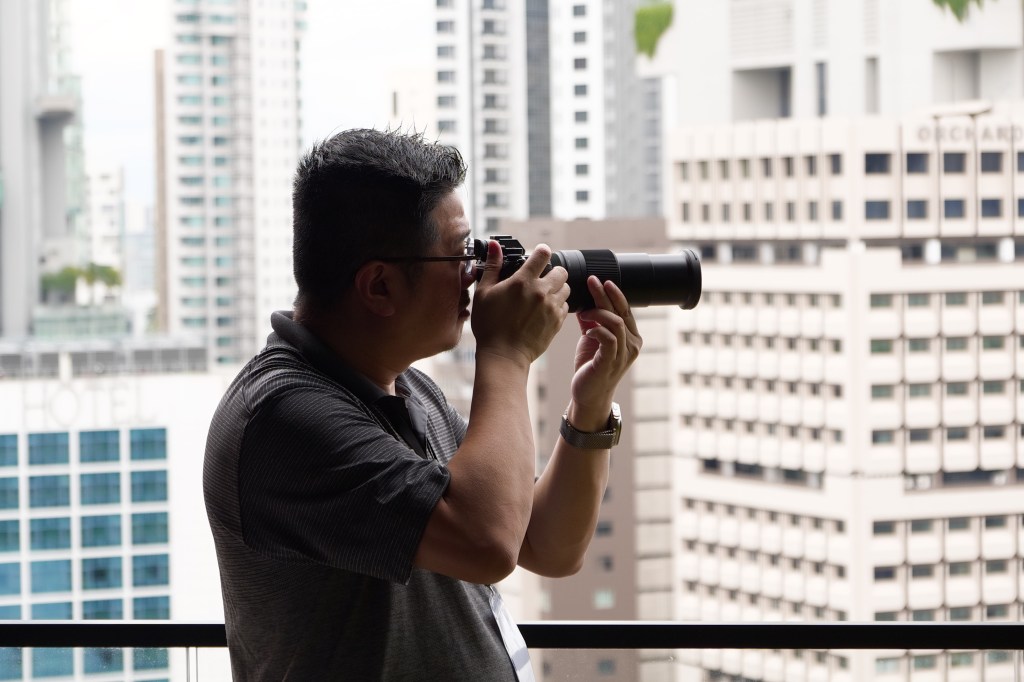
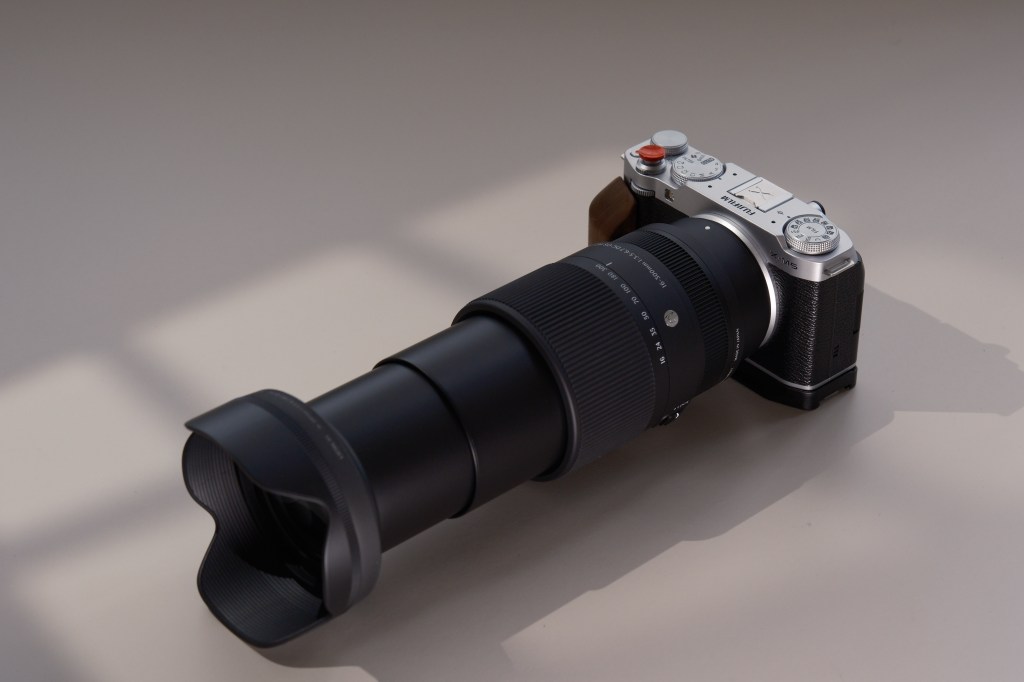
There are several lenses with several camera bodies. But somehow, I am fated to try with my recently reviewed Sigma 16-300mm f3.5 – f6.7 DC OS (and manage to test out the Sigma 90mm f2.8 too), at least I get to hold onto the silver color.
Sigma BF with Sigma 16-300mm f3.5 – f6.7Sigma BF with Sigma 16-300mm f3.5 – f6.7Sigma BF with Sigma 16-300mm f3.5 – f6.7Sigma BF with Sigma 16-300mm f3.5 – f6.7Sigma BF with Sigma 90mm f2.8
I went on a trip to Japan with my family in mid-March. Just days before the trip, I was still trying to figure out which lens to bring. Then, Mr. Lawson from Sigma Marketing (Singapore) reached out to me, asking if I’d be interested in testing the Sigma Contemporary 16-300mm f3.5 – f6.7 DC OS lens. This opportunity came at the perfect moment, resolving my lens dilemma.
Sigma 16-300mm f3.5 – f6.7 DC OS
Intro
The Contemporary 16-300mm f3.5 – f6.7 DC OS is Sigma’s first lens with an 18.8x zoom ratio. It is also the second long zoom lens made available to the Fuji X-mount community. This lens is offered in a variety of mounts, including RF-mount, E-mount, L-mount, and of course, X-mount. It was announced on February 13, 2025, alongside the stunning Sigma BF camera.
Before continuing, I’d like to extend my thanks to Mr. Lawson from Sigma Marketing (Singapore) for loaning me this lens for review, and to Kai for coordinating everything. I truly appreciate their generous support in making this review possible.
The lens is built with the familiar “Thermally Stable Composite” (TSC) polycarbonate material, the same used in Sigma’s 10-18mm f2.8, 23mm f1.4, and other Contemporary lenses. This construction ensures a solid, high-quality feel while keeping the lens lightweight. Weighing in at 615 grams, it is well-balanced with the X-T5, even though when it’s at the longer zoom.
Handling-wise, it’s generally good. The zoom ring is a bit stiff at first but loosens up with use. When collapsed at 16mm, the lens measures 123.7mm in length. When extended to 300mm, it stretches to 200mm, nearly doubling in size. Shooting at 300mm can be a bit challenging, as I found myself wobbling slightly when framing the shot with the X-M5. However, with the X-T5, the lens feels more balanced, providing better overall stability.
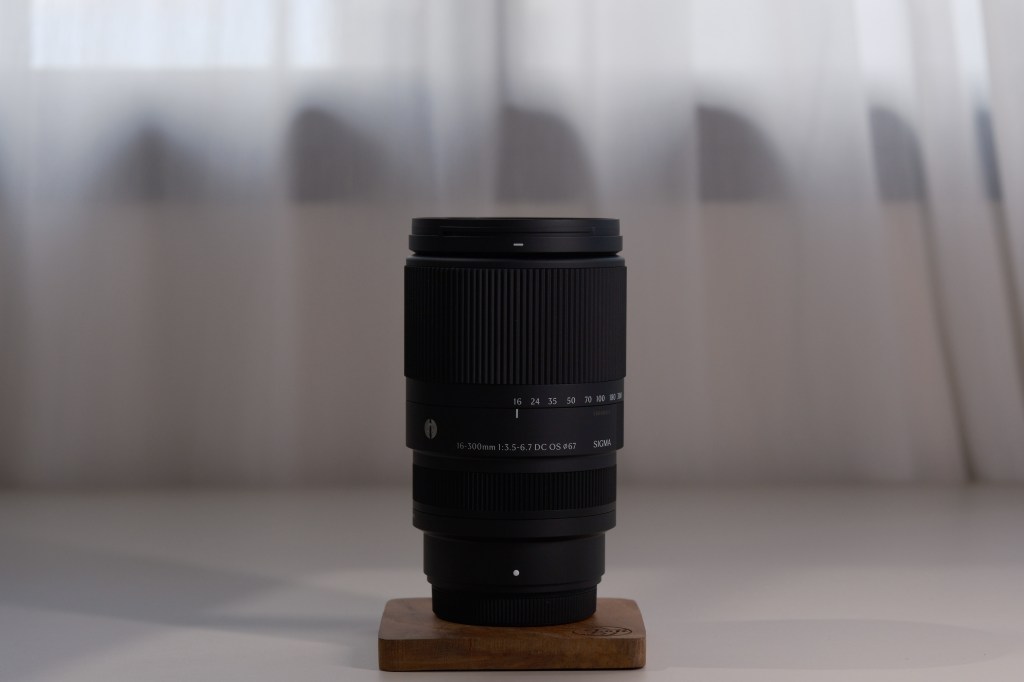
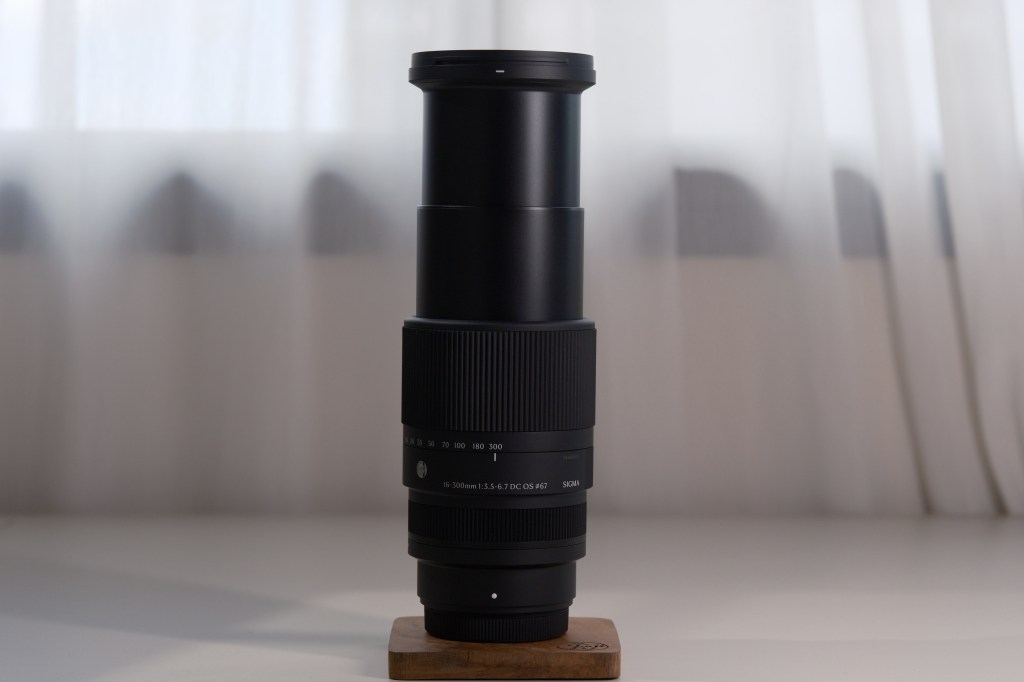
Left: Sigma 16-300mm f3.5 – f6.7 DC OS before extension Right: Sigma 16-300mm f3.5 – f6.7 DC OS extended to 300mm
The focus range from minimum focus distance to infinity is just 90°, which is quite efficient for a long-zoom lens. This allows for quick adjustments to the focal length without needing to turn the ring too much. It comes with 67mm filter size.
No lens is perfect. When you have the versatility of a wide focal length range, other aspects are often compromised, and in this case, it’s image quality. In my opinion, the image quality isn’t the best Sigma has delivered. It’s acceptable with nice contrast, but the sharpness tends to be soft at most focal lengths. The softness is particularly noticeable when shooting close to a subject and when viewing the image at 100%.
Chromatic aberration is generally well-controlled, with little to no noticeable issues in my photos. As for vignetting, it is present when shooting wide open, though it’s not very noticeable.
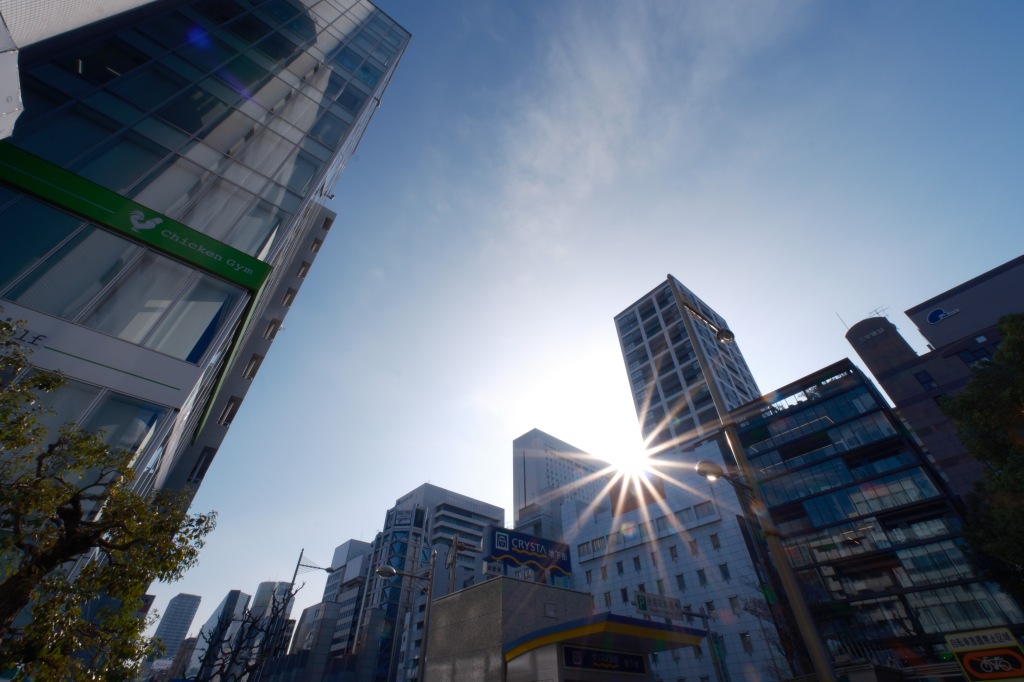
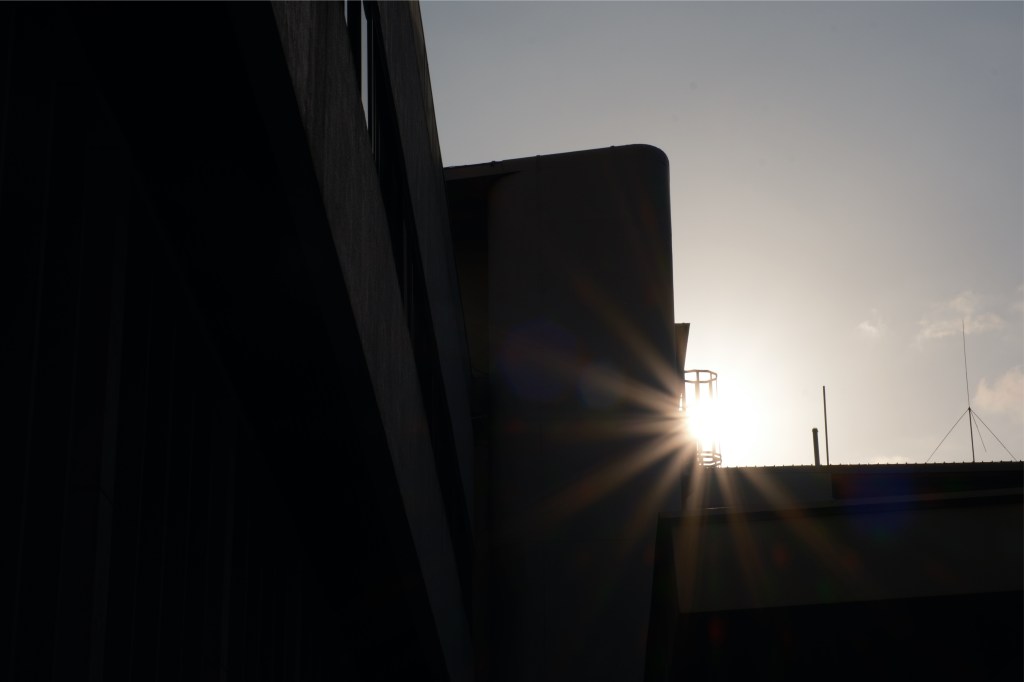
Regarding sun stars, I was able to capture them at 16mm, but not at 300mm. The result is soft but acceptable, without any dramatic effects.
Sigma employs a High-response Linear Actuator (HLA) motor for the autofocus system in this lens. Overall, the autofocus locking is quite fast across most focal lengths. However, at the telephoto end, particularly from 180mm onwards, there are occasions where the lens struggles to lock focus. Sometimes, I have to attempt to focus a few times before I lock onto the subject. On some occasions, I even need to refocus at a wider focal length before it can focus properly at the telephoto end. I hope this issue can be addressed with a future firmware update.
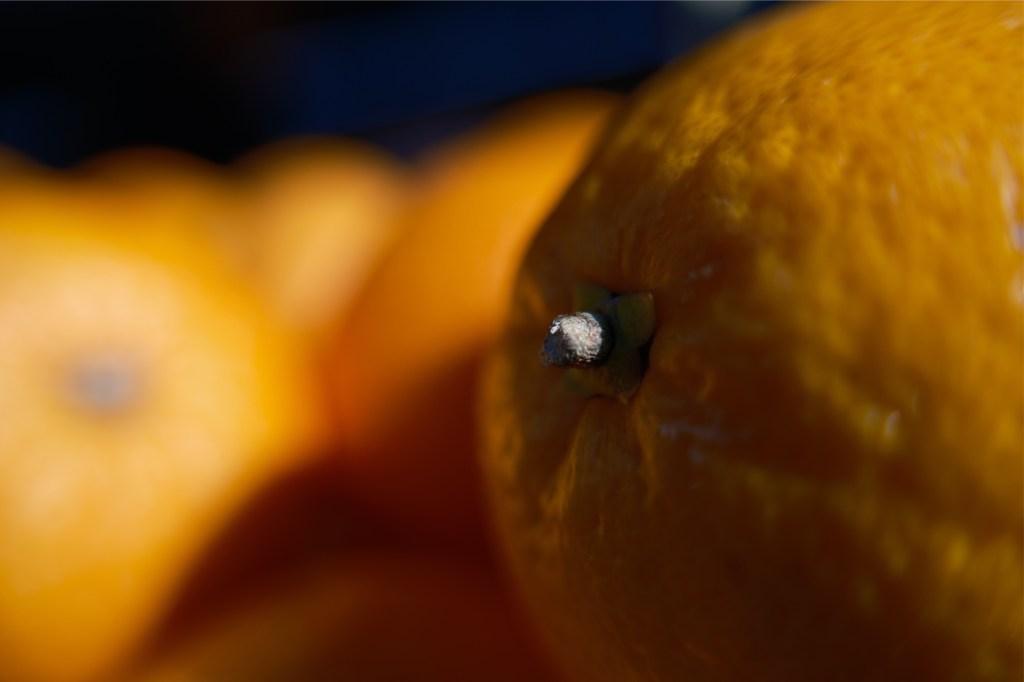
At 16mm, the minimum focus distance (MFD) is 17cm, which means I have to remove the lens hood to get close enough to the subject. At 300mm, the MFD is 105cm, making it a bit tricky to frame the shot with my shaky hands.
However, Sigma notes that the best magnification ratio of 1:2 is achieved at 70mm. In my testing, though, the image quality remained consistent across all focal lengths, with the same characteristics as mentioned earlier.
At 699 USD / 1088 SGD, the price is highly competitive. It’s clear that this lens directly competes with the Tamron 18-300mm, which is priced at 699 USD / 1099 SGD.
(I’m aware that Tamron Singapore currently has a promotion offering an attractive price of 991 SGD, and on Amazon Singapore, it’s available for 768 SGD.)
Others
This lens features an Optical Stabilizer (OS), which, according to the specifications, provides up to 6 stops of stabilization at the wide end and 4.5 stops at the telephoto end. In real-world use (I turned off the IBIS on the X-T5 during this trip), I had no issues shooting in daylight at any focal length. However, in low-light or challenging conditions, the OS performs well at wide focal lengths but is less effective at the telephoto end, where I experienced some handshake. This is likely due to the lens’s smaller aperture.
This lens is designed for travel photographers who prefer to carry just one lens that covers a wide range of focal lengths, even if it means sacrificing some image quality and adding a bit of weight. It’s also ideal for photographers who want to simplify their lens setup.
When Tamron released their 18-300mm f3.5 – f6.3 lens, many Sigma fans were hoping for a Sigma version, and now it’s here. I believe Sigma has delivered a great response to that demand.
To quickly compare, the Sigma 16-300mm (24mm to 450mm in full frame equivalent) offers a slightly wider focal length at 16mm, compared to Tamron’s 18mm. However, the Sigma lens has a slightly smaller aperture at the 300mm end, but in my opinion, this difference is negligible and doesn’t significantly affect shutter speed or other settings. The Sigma lens is also just 5 grams lighter than the Tamron, which again, is insignificant. Ultimately, it comes down to whether you prioritize a wider focal length or a lower price.
In my view, the wider focal length is more important, as it’s always handy to have that extra 2mm for those “just-in-case” situations.
Thank you for reading.
Fuji X-M5 with Sigma 16-300mm f3.5 – f6.7 DC OS Left: Sigma 16-300mm f3.5 – f6.7 DC OS with lens cap Right: Sigma 16-300mm f3.5 – f6.7 DC OS extended with lens cap
Disclaimer: 1. All the shots taken here are shot by me. 2. Most of the shots are straight out of the camera with some shots edited via In-Camera Raw Processing. 3. The opinions are based on my experience. If there is any mistake, please kindly drop me a message and I will gladly make the amendment. 4. I reserve ownership of these images, if you wish to use my images, please notify me.
If you like my works, please follow me on either one of the 2 Instagram accounts:
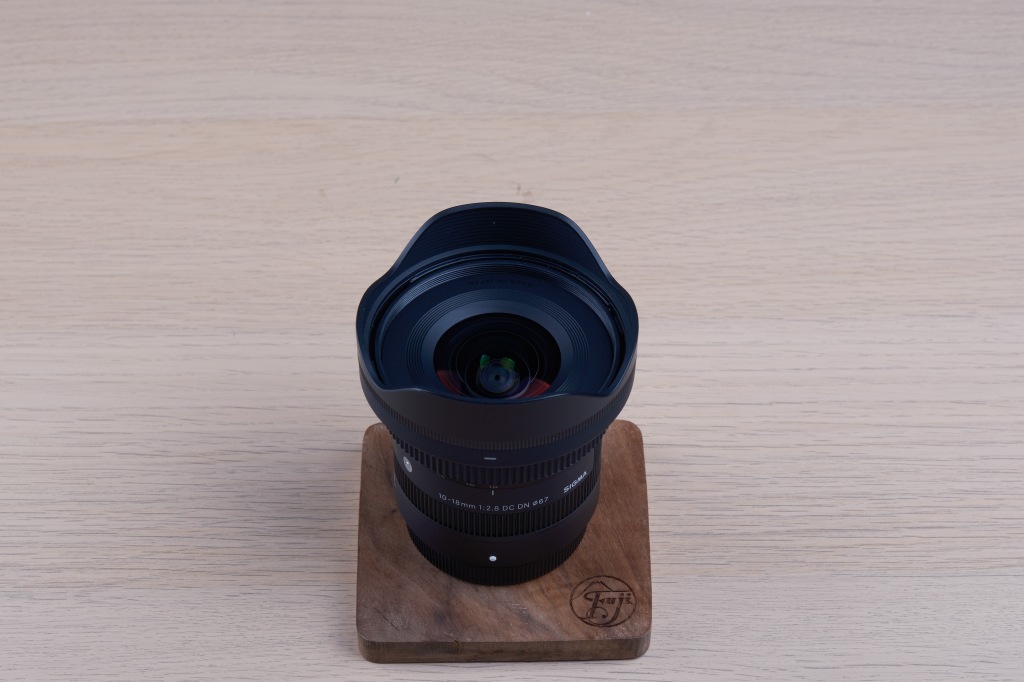
When Sigma 10-18mm f2.8 DC DN is revealed to the world, by just looking at the focal lengths and the constant f2.8 aperture value, it is a very straightforward indication that this is the lens that compliments and co-exists with the Sigma 18-50mm f2.8 DC DN. This is the latest lens joining the Sigma Contemporary series for APS-C cameras. No surprise here, this lens is available for the L-mount and E-mount beside the X-mount.
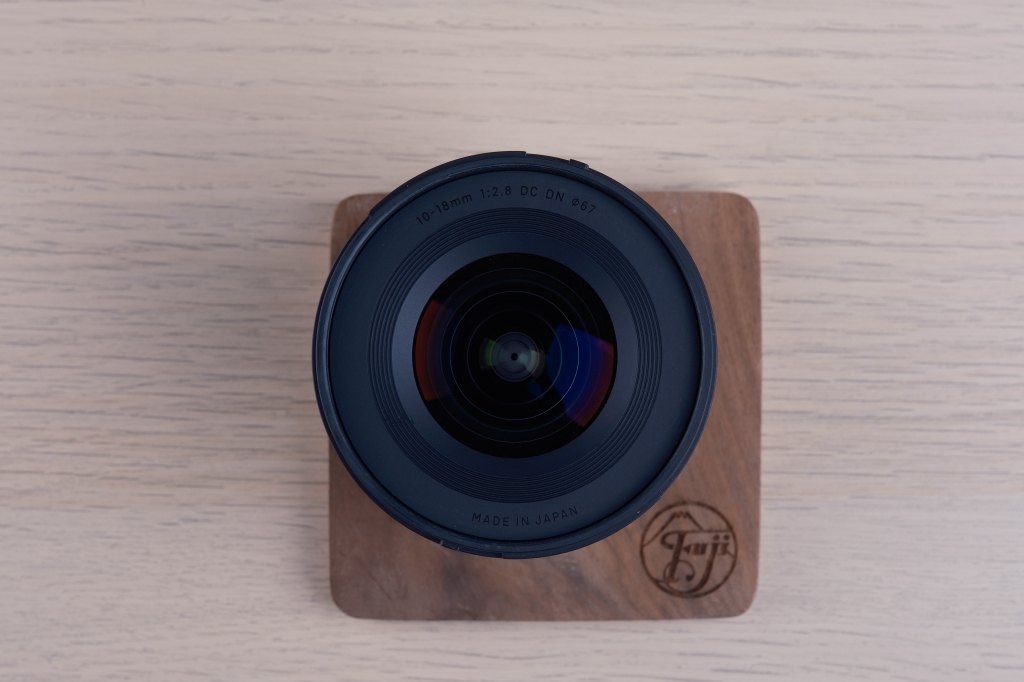
Sigma 10-18mm f2.8 DC DN ContemporarySigma 10-18mm f2.8 DC DN Contemporary Left: @10mm, Right: @18mm
Intro
Sigma 10-18mm f2.8 DC DN Contemporary
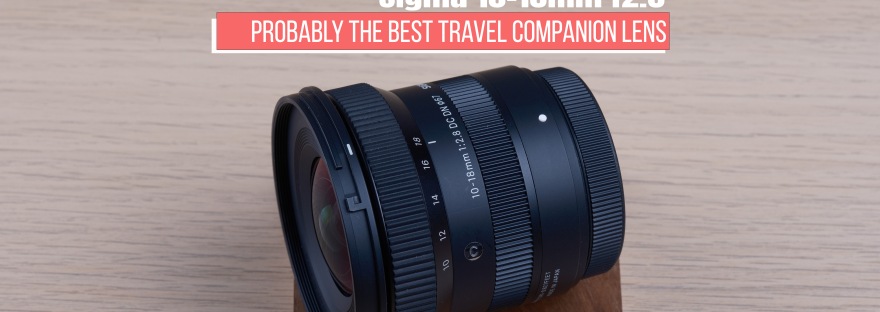
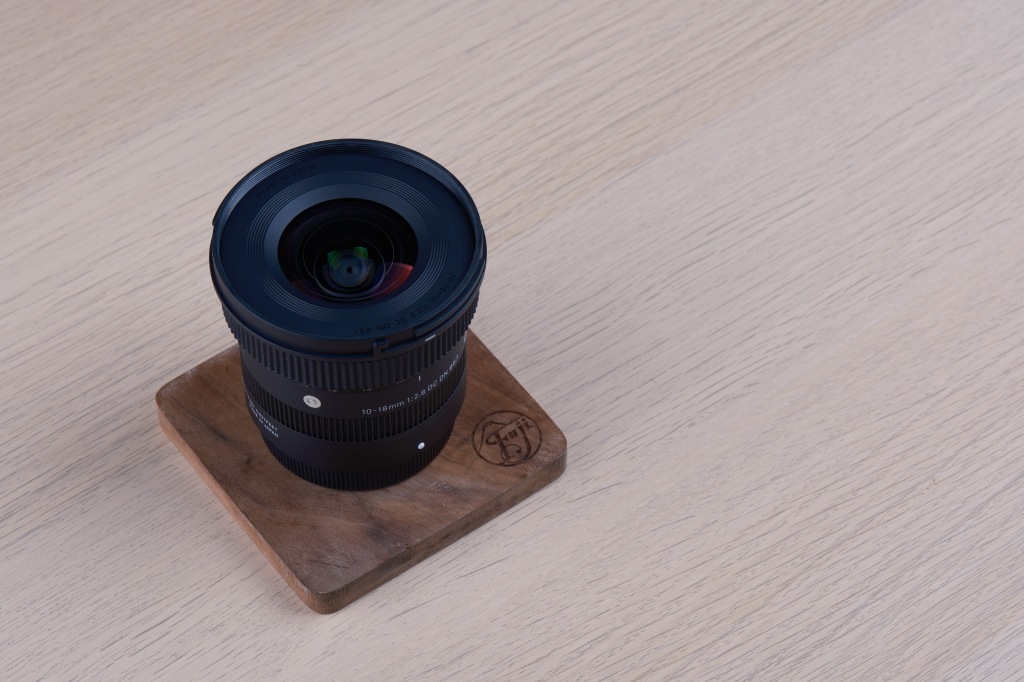
“Smallest” and “lightest” are the most common words on the headlines in most sites to describe this lens. From the press release images, it looks compact but I have no idea it is that compact until I get to hold one on my hand.
“Wow” is the first word that comes out of my mouth and I am impressed by the actual size and weight of this lens. An f2.8 constant aperture lens can be this small and light is something of an engineering marvel. I am truly impressed with the Sigma engineers and their dedication to making such an impressive lens. But how will the image quality and the autofocus system be in such a compact design? The only way to find out is to test it out.
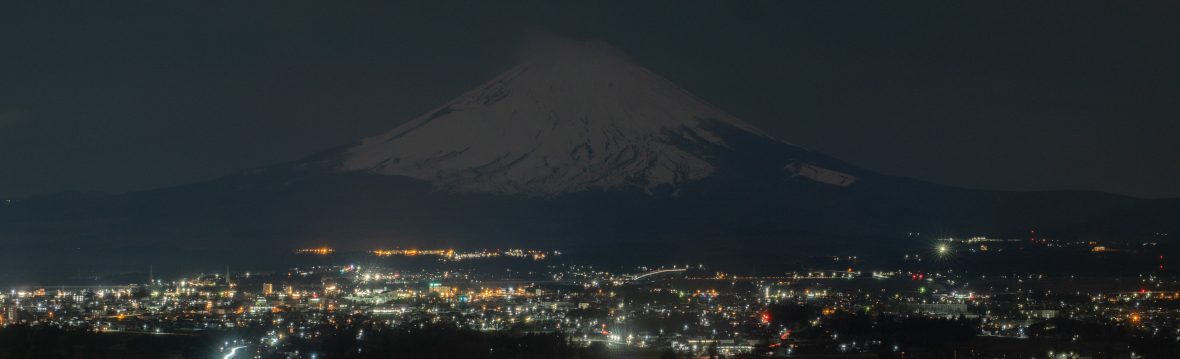
Apart from the Meike 12mm f2, this is another lens I brought with me to my recent Japan holiday trip.
Before I proceed further, Iwould like to thank Mr Lawson from Sigma Marketing (Singapore) for loaning me this lens for review and Kai for making the arrangements. I appreciate their kind support in making this review a reality.
Design and Build Quality
The lens build is identical to its siblings like the Sigma 18-50mm & Sigma 56mm f1.4, etc. The same minimalistic look profile and also without the aperture ring. Yes. I do miss the aperture ring.
The lens is made of “Thermally Stable Composite” (TSC) polycarbonate material, which gives a lightweight yet very high-quality and well-built lens body. Polycarbonate material is probably one of the best plastic materials on the market at this point in time.
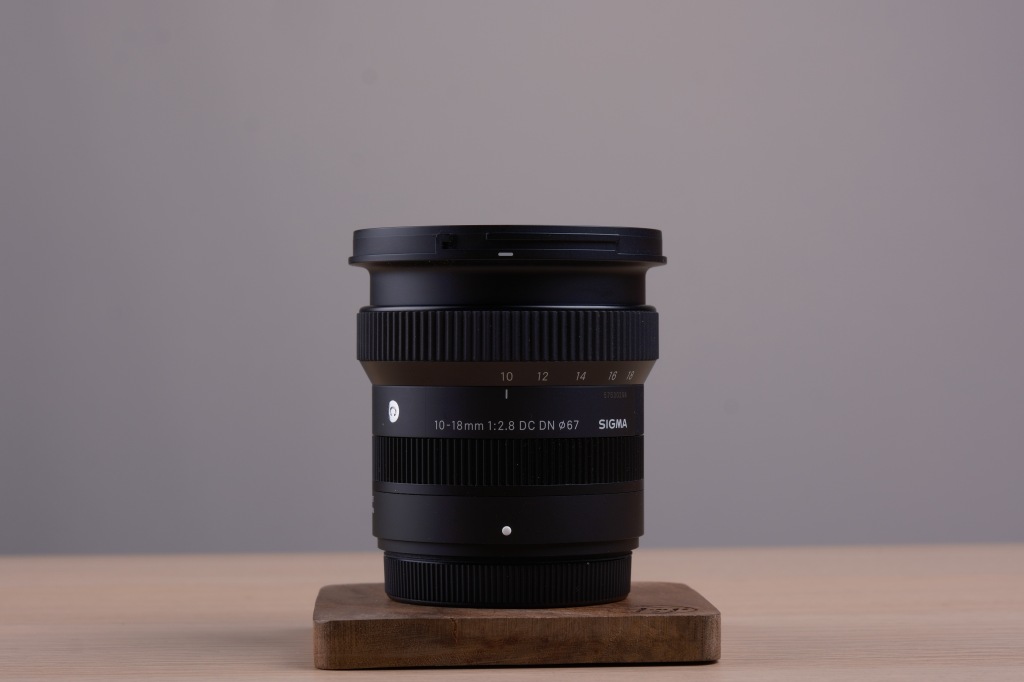
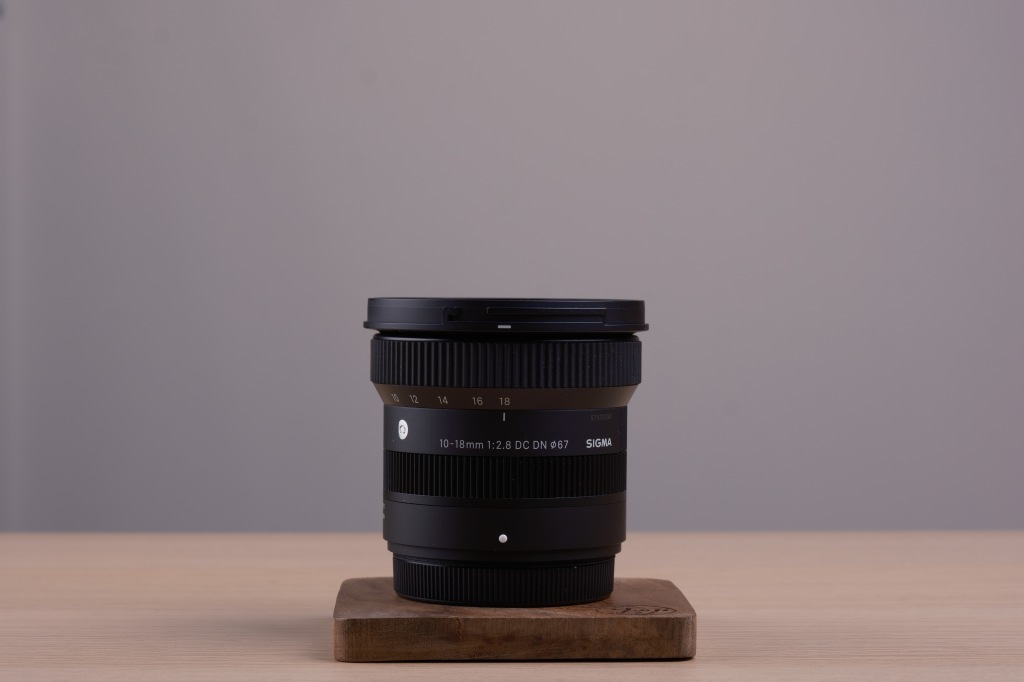
When I held the lens for the first time, I noticed that the focal length starts at the tele end (@18mm) instead of at the widest focal length (@10mm). This is a similar approach to the Tamron 11-20mm f2.8, which practically makes sense as the tele-end will be the most used focal length most of the time. In this case, 18mm is a very usable focal length for street photography.
For a note, the lens is zoomed out by extending a little bit at 10mm. It does not bother me throughout my testing period.
The 15mm to 28mm (in full frame equivalent) comes with a filter size of 67mm and it is surprisingly small for the ultrawide lens. With the combination of 250 grams (other mounts have slightly different weights), this lens is really lightweight and very suitable to be a traveling lens.
There are rubber sealings in this lens to provide dust and splash-resistant. Having said that, I am not the person who dares to push the boundary and fight against the weather with my camera gears. After all, this is a nice touch for Sigma to provide this for all the contemporary lenses for the X-mount.
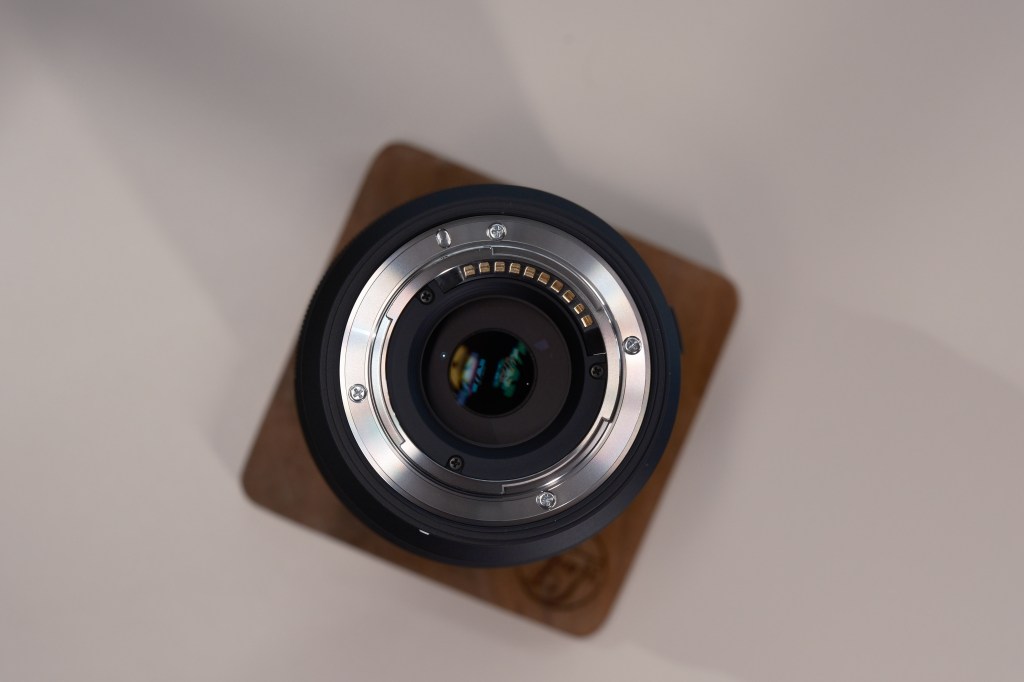
Like other contemporary lenses, it has a metal rear mount bayonet. And also, it is made in Japan.
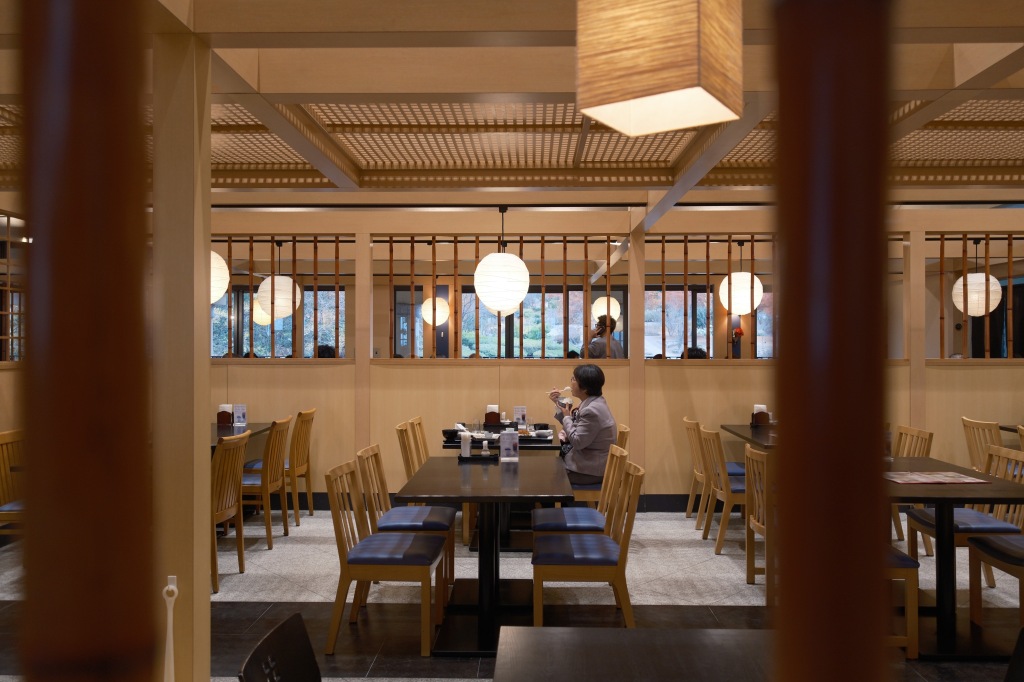
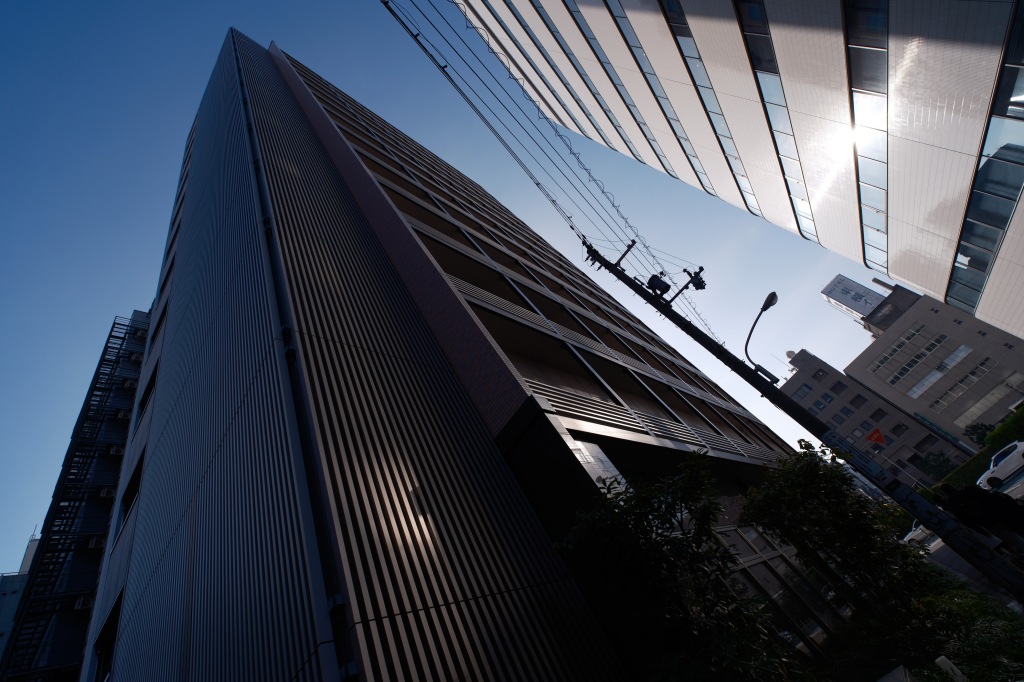
The image quality is exceptionally good for an ultrawide lens. At wide-open, the sharpness and contrast are great throughout the focal lengths. The images that I take are very usable and I have no complaints with the image quality department.
If you are picky, distortion at the widest end can be observed but is minimal (or maybe it is corrected by the camera). Chromatic aberration is pretty well-controlled or I should say I do not observe any during my shoots. At f2.8, vignetting is there but not as heavy as I thought. In my opinion, it is fairly well-controlled and it is pretty okay for my consumption.
As for the sun star, it forms pretty well with sharp edges but it also introduces flares as well. It seems more to me like the characteristic of the lens but others might think otherwise. Nevertheless, if you do not want to have flares, avoid facing the sun or a strong direct light source.
When comes to focusing performance, it is not fair to compare with the new generation XF prime lenses like the XF23mm f1.4 WR, so I will just base it on my personal experiences.
In my opinion, the lens’ focusing performance is pretty fast, silent, and snappy by today’s zoom lens standard. The stepping motor does a great job and I find that the focusing speed is very consistent even at night and pretty high accuracy rate too. But I do experience some misfocus but it is really rare. If I remember correctly, it’s just 2-3 times.
The lens breathing is also at its minimal for both 10mm and 18mm. This is great if videographers plan to use this for their work.
Minimum Focus Distance (MFD)
When comes to MFD, oftentimes there are two MFD values for a zoom lens and this is no exception for this lens as well.
At 10mm, it can go as close as 11.6cm. To put that into practicality, the front lens is basically close to touching the shooting subject. It is that close and I often cast a shadow on the subject that I wanted to shoot.
At 18mm, 19.1cm is the MFD and it is slightly better than the XF18mm f1.4 20cm MFD.
Overall, I am glad that the image quality still maintains quite well at both MFDs.
Price Point
This lens is selling at 599 USD. With this price point, it can easily become one of the lenses in consideration.
For comparison, XF10-24mm f4 WR is selling at 999 USD and Tamron 11-20mm 829 USD. How can one resist such a price point? I have to say it is a great price point and Sigma is really good at pricing their products well.
One interesting thing about this lens is the lens hood. Sigma has a newly developed push-on petal-type lens hood. This new mechanism is so much more convenient and faster than the traditional lens hood mounting method.
But one might wonder how durable is it as compared to the traditional one. For this, I also wish to know the answer but I also know I dare not try to do a lens drop test. Nonetheless, I hope to see more lenses using this approach to make easy for photographers.
One can’t help but compare Tamron 11-20mm and Sigma 10-18mm. Both have their pro and cons but end of the day, it depends on the photographer which one he/she prefers to use. I have my answer but I will keep it on my own.
Also, updating lens firmware is the same as how we update the firmware for Fujifilm. Download the firmware from Sigma’s official website, transfer it to the SD, and update the lens firmware.
Who is this for?
With this lens’ ultrawide zoom versatility, genres like landscape, cityscape, street, architecture, and astrography are the common ones. And not forgetting, the traveling genre too!
As a street photographer, I like this lens for having 18mm at its tele-end and it is a more commonly used focal length for street photography which does not make me lose out on most of my street shots. When I need to take some much wider shots, it gives me the flexibility to go wider than 18mm. This is something I appreciate when traveling overseas.
With the current Sigma 10-18mm and Sigma 18-50mm, these 2 lenses make the best companion for travelers. With a combination of 15 to 75mm, both lenses covered most of my needs for travel. Not forgetting that compact and lightweight (a total of 535 grams for both lenses) play an important part in the overall travel experience.
I have been thinking Sigma has been planning to cover the tele zoom range as well, making a trinity f2.8 zoom lens covering most photographers needs. Plus, the recent rumors about Sigma planning to release the 50mm to 135mm (or 140mm), makes me strongly believe that this is going to happen.
Nevertheless, I really like this lens and I think I will get this lens for my own usage.
Thank you for reading.
Disclaimer: 1. All the shots taken here are shot by me. 2. Most of the shots are straight out of the camera with some shots edited via In-Camera Raw Processing and Capture One. 3. The opinions are based on my experience. If there is any mistake, please kindly drop me a message and I will gladly make the amendment. 4. I reserve ownership of these images, if you wish to use my images, please notify me.
If you like my works, please follow me on either one of the 2 Instagram accounts:
23mm focal length (35mm in full frame equivalent) is one of my favorite prime lenses. If I can only bring one lens out, this is the focal length I will bring. No second thought. And now, Sigma has this amazing lens ready for the X-mount, L-mount, and E-mount.
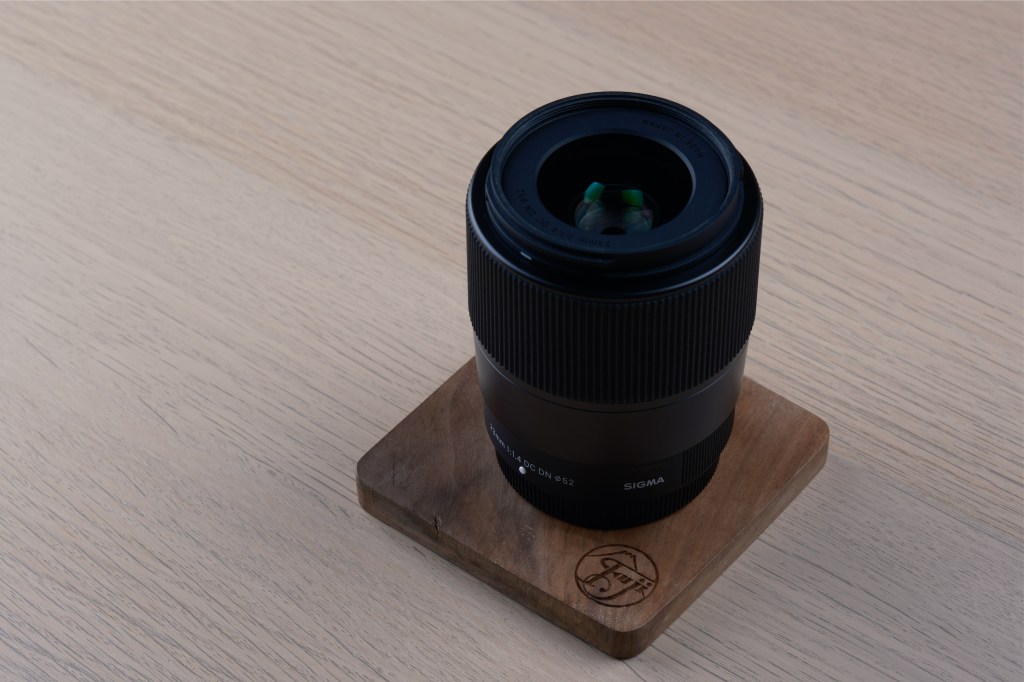
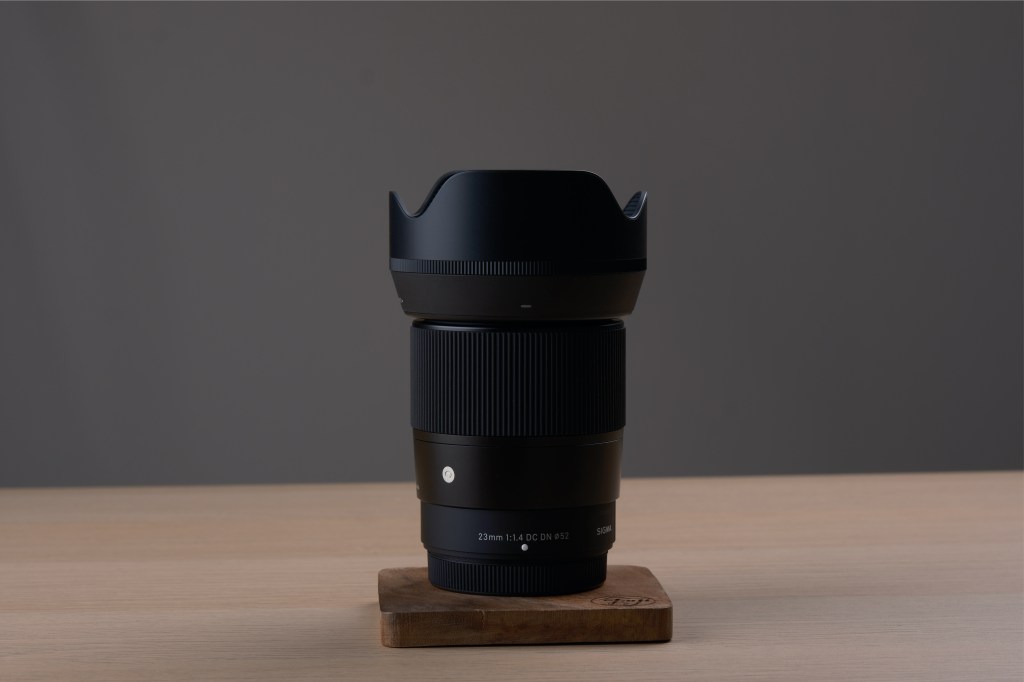
Sigma 23mm f.14 DC DN Contemporary
Intro
Sigma 23mm f1.4 DC DN Contemporary was released officially in September 2023, but it was announced way back in April 2023.
Sigma 23mm f.14 DC DN Contemporary
If I remember correctly, this is Sigma’s 4th prime lens. It may not sound a lot, but Sigma did cover basically the most commonly used focal lengths for street photographers.
Sigma 23mm f.14 DC DN Contemporary
Before I proceed further, I would like to thank Mr Lawson from Sigma Marketing (Singapore) for loaning me this lens for review and Kai for making the arrangements. I appreciate their support in making this review a reality.
Design and Build Quality
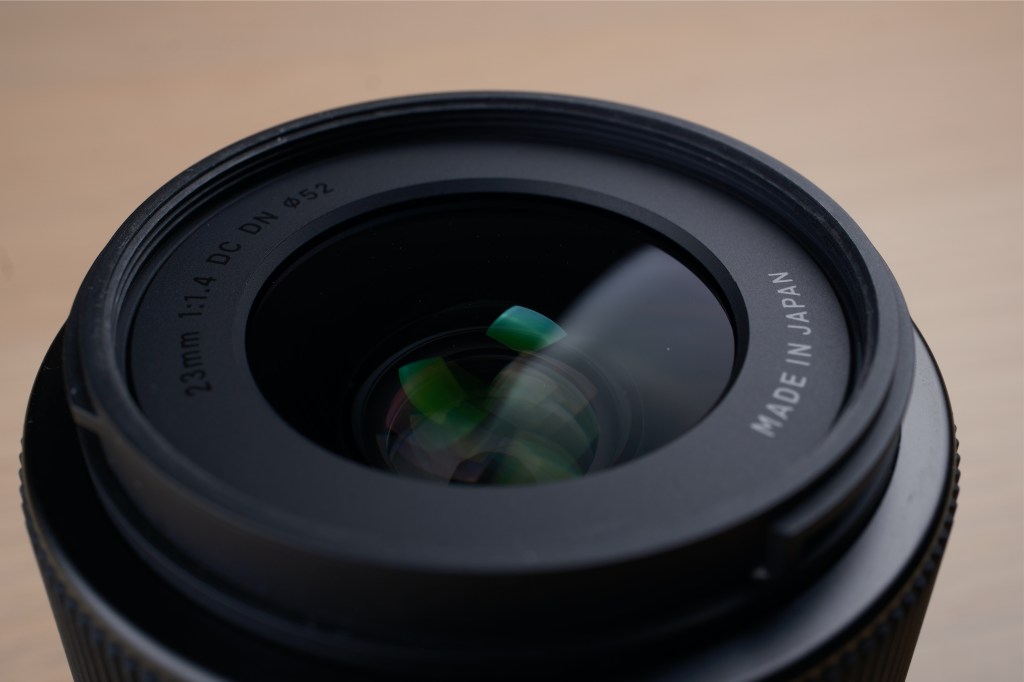
From the first look, this lens shares many similarities with the other Contemporary series like the Sigma 18-55mm, Sigma 56mm, etc. The lens gives a very minimalistic look, nothing fancy, just a low-profile lens design. The lens is made of “Thermally Stable Composite” (TSC) polycarbonate material, which gives a very high quality, well-built lens body.
At 335 grams, this lens is very comfortable to hold, and it comes with a 52mm filter size (For your information, it is the same filter size as the Sigma 30mm f1.4). It also comes with a plastic lens hood.
In the same manner, this lens is also equipped with dust and splash-resistant sealing that helps to protect the lens from certain weather/environmental conditions. Last but not least, it does not come with an aperture ring.
I think this is probably the better image quality as compared to the other Sigma prime lenses. At wide open, the image is great, sharp, and contrasting. If I set XF23mm f1.4 WR as the benchmark, this Sigma lens is just one tier lower. This is very impressive in my opinion.
The blur transition between the focused and non-focused object is not the best I have since but it is decent too. Not harsh or distracting.
Vignetting is there at wide-open. But again, not a critical concern to me. Chromatic aberration is nowhere to be found or at least I did not spot one during my course of testing.
If anyone is concerned about the sun star result, it is okay, not the best but also the worst.
Focusing
With the help of the stepping motor, the lens performs very well. In most situations, the focus is quick (not the fastest) and accurate. So far, I have not experienced any miss-focused shots which I think is another great experience to have.
But under challenging situations like a dim environment, it does pose a bit of a challenge to focus. This is pretty much the same behavior as most lenses in the market.
The focus ring is smooth as expected. Nothing to complain about. Also, Sigma did a good job at controlling the lens breathing. Not too much of a concern for photographers, but if you intend to use this lens for videography, I think it might be a good option.
Minimum Focus Distance (MFD)
While 25cm MFD is not the shortest for this focal length, it is pretty usable. It is still allowing photographers to take close-up subject if he/she wants to. The image quality might seem to be a little softer at wide-open. Unless you do pixel peeping, it is barely noticeable.
It is priced at 549 USD. For comparison, XF23mm f.14 WR is priced at 899 USD, Viltrox 23mm f1.4 is priced at 325 USD, Voigtlander Nokton 23mm f1.2 is priced at 599 USD (not quite a fair one but I just throw it in for price sensing purpose).
The “metallic” surface of the lens is prone to fingerprint smudge but this is the same across all contemporary prime lenses thus far. But not too much of a worry as it can be removed easily with a cloth.
If you are new to photography or want to own the first decent-quality prime lens but are on a budget, I will always recommend a 23mm prime lens as a start. Because as a prime lens, it is versatile for the street, cityscape/landscape, documentary, environmental portrait, astrophotography, editorial, and the list goes on.
Hence, this Sigma 23mm f1.4 can be one of your considerations. There is not much of a 23mm focal length competition just yet. I know there is a brand or 2 that have the intention to enter this 23mm segment but I am totally not sure how good their lens and the image quality will be. But Sigma has been around since 1961 and has been accompanying many photographers in their photography lives. So the image quality is at a certain standard.
As a third-party lens, Sigma 23mm f1.4 set a benchmark for many others to follow. Fantastic image quality, decent focus speed, and comfortable lens handling. As for the lens build, it may not be as good as what metal built quality is but it is definitely a premium polycarbonate build quality. Trust me, I experienced the not-so-good one.
Sigma may not seem to release lenses aggressively for Fujifilm. But if we look back, it is otherwise. In fact, Sigma had released lenses for Fujifilm at a good momentum throughout the years. Today, Sigma has released a good range of prime lenses for street photographers.
Finally, I have to say this is by far one of my favorite Sigma lenses and I hope Sigma will continue to support the Fujifilm X-mount and also probably the G-mount soon?
Thank you for reading.
Disclaimer: 1. All the shots taken here are shot by me. 2. Most of the shots are straight out of the camera with some shots edited via In-Camera Raw Processing and Capture One. 3. The opinions are based on my experience. If there is any mistake, please kindly drop me a message and I will gladly make the amendment. 4. I reserve ownership of these images, if you wish to use my images, please notify me.
If you like my works, please follow me on either one of the 2 Instagram accounts:
As the title suggests, please take this comparison with a pinch of salt. It’s just for fun and nothing too technical to share and discuss. This is something I did not try before but there is always a first time.
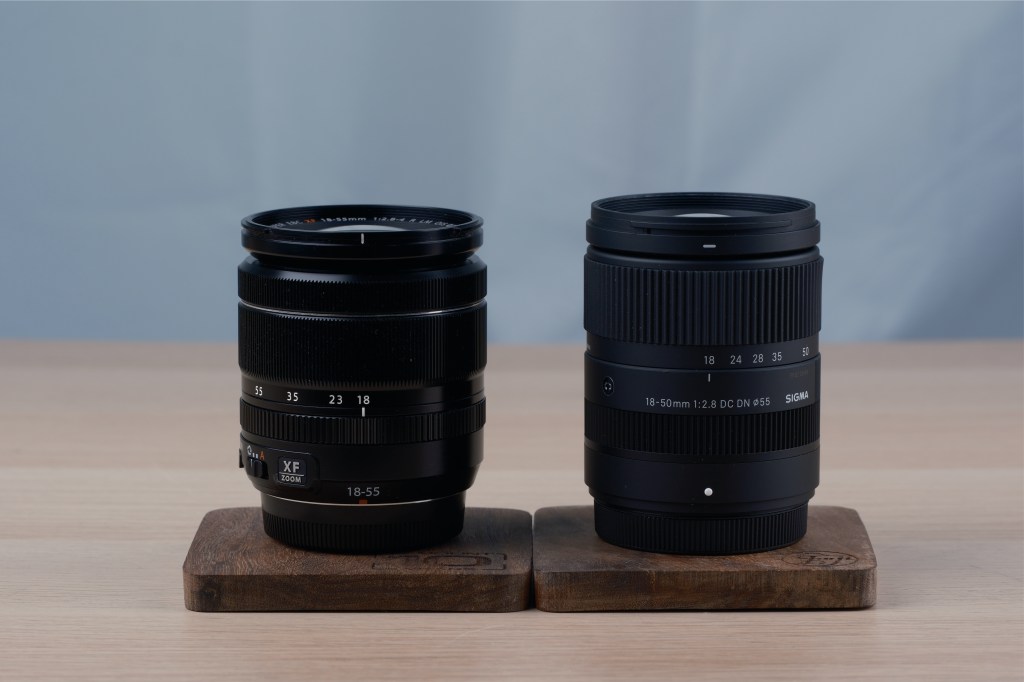
First thing first, why compare these 2 lenses? My reason is simple. They are approximately the same size and same price range (approximately 150 USD different) for brand new. Some might suggest why not compare the Sigma 18-50mm with the XF 16-55mm instead. In my opinion, they are not the same size and you can buy 2 of the Sigma 18-50mm lenses and have some cash left. To cut things short, they are in a different league.
Here we go.
Left: Sigma 18-50mm f2.8 @ f2.8. Right: XF 18-55mm f2.8 – 4 @ f2.8. Shoot at approximately 50 cm. Both at 18mm.
Left: Sigma 18-50mm f2.8 @ f2.8. Right: XF 18-55mm f2.8 – 4 @ f2.8. Shoot at 30 cm. (XF 18-55mm minimim focus distance). Both at 18mm.Sigma 18-50mm @ f2.8 @ 18mm . minimum focus distance @ 12.1 cm
Left: Sigma 18-50mm f2.8 @ f2.8 @ 50mm. Right: XF 18-55mm f2.8 – 4 @ f4 @ 55mm. Shoot at approximately 100 cm.
Sigma 18-50mm f2.8 @ f2.8 @ 50mm. Shoot at approximately 100 cm.
In conclusion: Despite having 5mm shorter than the Fuji, Sigma has more versatility. All thanks to the capability of shooting at a much closer Minimum focus distance at both wide and tele ends. As for image quality, I think they come in quite close together. What do you think? Are you willing to sacrifice the aperture ring and the metal build lens to opt for a Sigma 18-50mm f2.8?
Thank you for reading.
Disclaimer: 1. All the shots taken here are shot by me. 2. All shots are straight out of the camera. 3. The opinions are based on my experience. If there is any mistake, please kindly drop me a message and I will gladly make the amendment. 4. I reserve ownership of these images, if you wish to use my images, please notify me.
If you like my works, please follow me on either one of the 2 Instagram accounts:
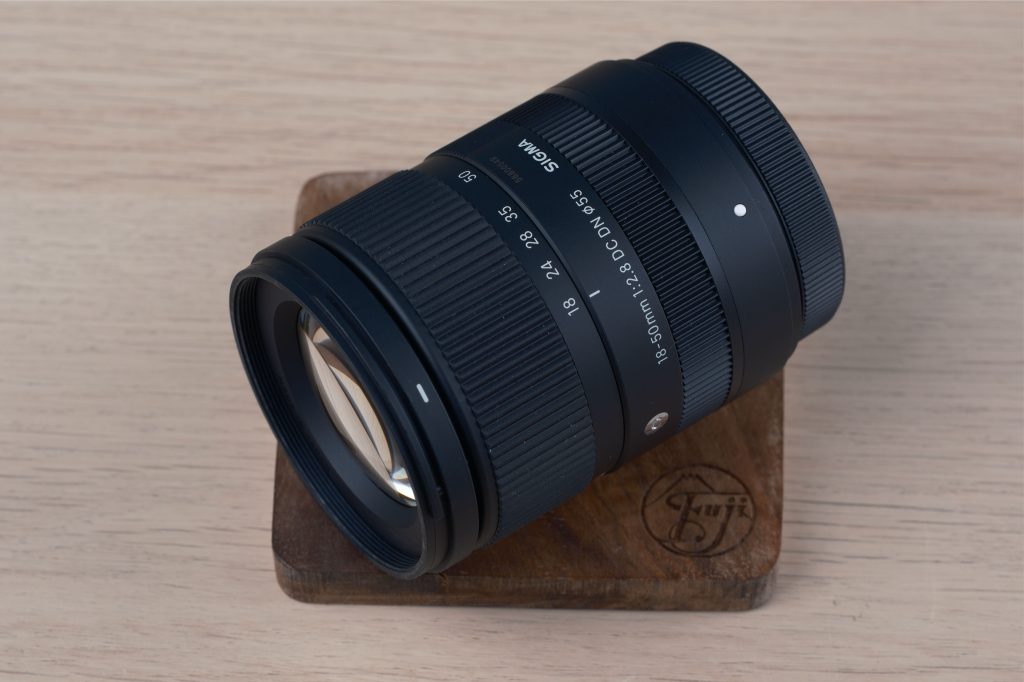
When it comes to third-party zoom lenses, Fujifilm photographers do not have many options. If I remember correctly, Sigma 18-50mm f2.8 DC DN Contemporary is the 3rd zoom lens (among the third-party lenses), and it is the first zoom lens from Sigma for Fuji available in the market.
Sigma 18-50mm f2.8
Sigma 18-50mm f2.8 was announced way back in October 2021 but that was meant for L-mount and E-mount cameras. The X-mount version was only announced merely one year later.
When I think about a constant f2.8 zoom lens, my perception of the lens is that it should be a huge lens, a big filter size, and be heavy. Sigma did a wise choice by doing something different with this lens. It is totally the opposite of what I just mentioned. It is so compact and small. And I can’t help thinking this might be a perfect choice to bring for travel.
Sigma 18-50mm f2.8
Before I share further, allow me to thank Mr. Lawson from Sigma Marketing (Singapore) for loaning me the Sigma 18-55mm f2.8 Contemporary DC DN lens for review. I appreciate his support to make this review a reality.
Design and Build Quality
The overall design language of this lens shares a lot of similarities with Sigma 16mm f1.4, Sigma 30mm f1.4, and Sigma 56mm f1.4. It does not come with an aperture ring and the lens body is polycarbonate (also known as Thermally Stable Composite TSC) constructed.
Having said that, this 285 grams lens (it is just 5 grams heavier than the Sigma 56mm f1.4 and 10 grams heavier than the Sigma 30mm f1.4) is genuinely great to hold with and the built quality is very sturdy and it does not give out a sense of cheap feeling.
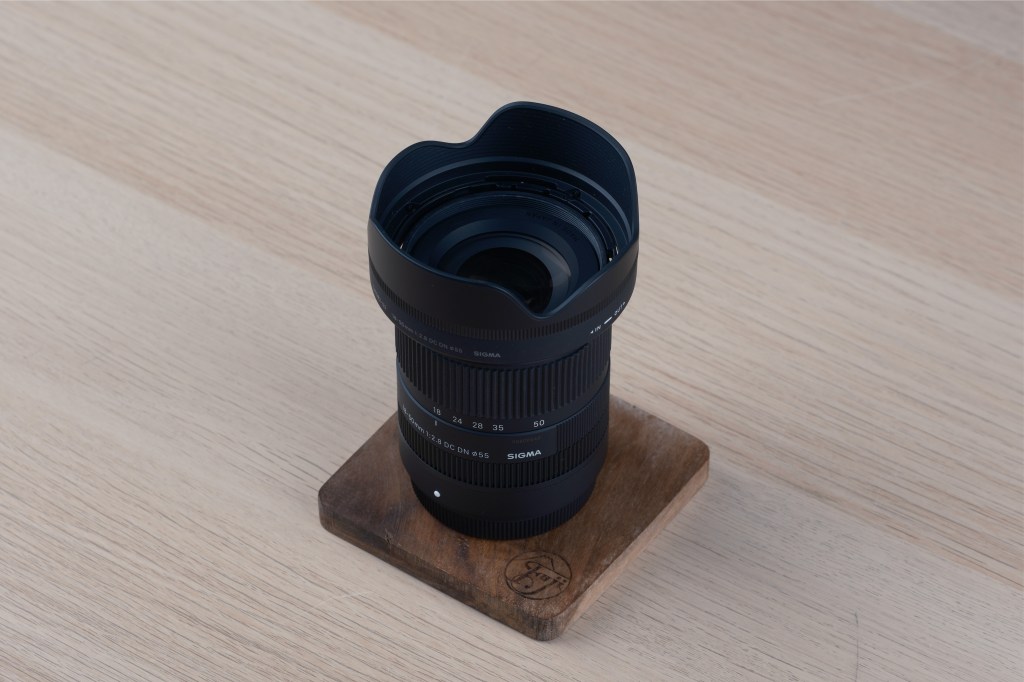
The 28-75mm (in full-frame equivalent) also comes with dust and splash resistant. This compact lens comes with a filter size of 55mm which is very decent and photographers who buy filters are delighted to know about it.
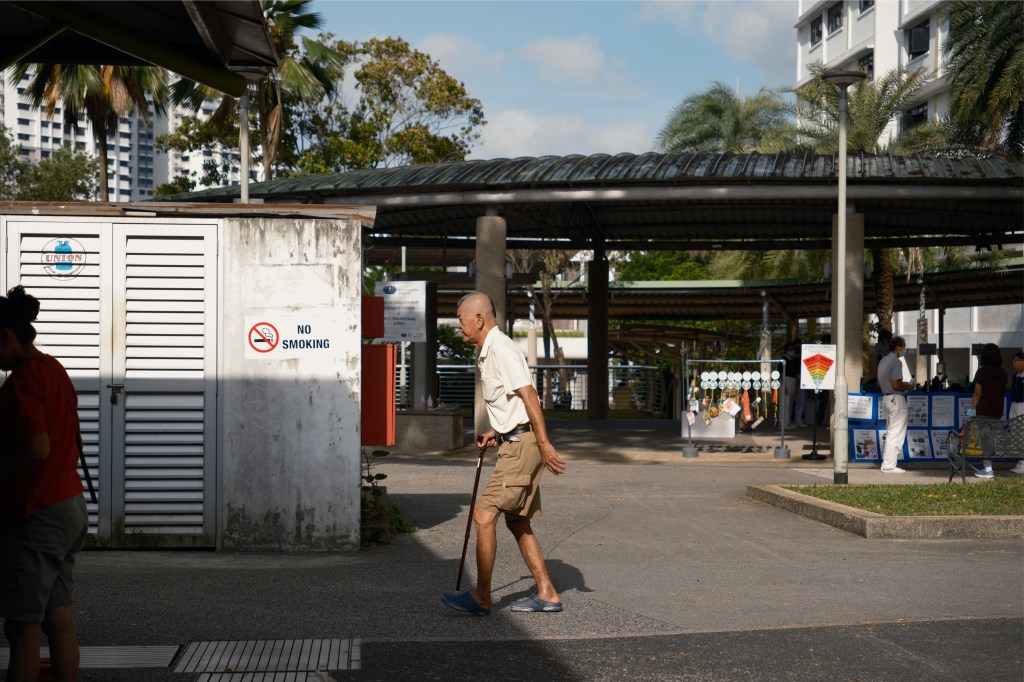
I have to say… The image quality coming out of this glass is great. The sharpness and contrast are great. At f2.8, the image is totally usable. The details are tremendous and resolve very well with my X-T5’s 40 megapixels sensor. This shows there are some quality and engineering works done with Sigma’s engineering team.
Although I am more of a prime lens user, I get to use or test with some zoom lenses. To be fair, prime lenses are still on better image quality, much sharper, and have better contrast. So if I am to compare the Sigma 18-50mm with the other zoom lenses, I think I am really impressed with this lens’ optic quality.
At wide open, the bokeh is very good with a very decent and gentle fall-off between the subject and background/foreground. I do observe very mild chromatic aberration and vignetting and I think it is within my acceptable range.
This lens comes with a stepper motor but, to be frank, the focusing performance surprises me. In good lighting conditions, it is really fast in focus locks onto the subject. Almost instantly. And I do not hear any sound produced by the focusing motor. It is silent.
However, I do occasionally experience slowing down and have the push-pull effect before it focuses on the subject. But it recovered quickly and the same behavior did not occur immediately.
As for challenging lighting conditions, I do see it struggle a little more before focusing on the subject. I think this is normal since most lenses have very similar behavior.
Minimum Focus Distance (MFD)
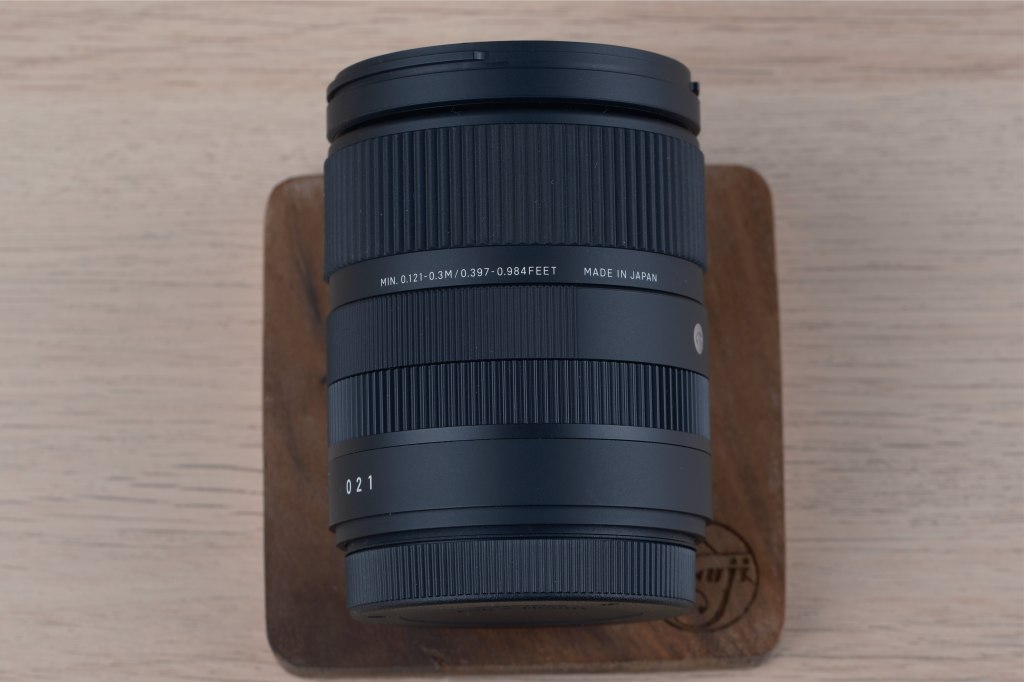
At 18mm, it has the shortest MFD of 12.1 cm. How close is that? You have to remove the lens hood to get that close. Otherwise, you will get the shadow of the lens hood in your shots.
At 50mm, it too has the shortest MFD for the same focal length. I haven’t come across any 50mm lens to have 30 cm MFD. With such a close MFD, it is very impressive to give me a new point of view.
At MFD, the shots retent their sharpness and contrast pretty well with a little bit of softness.
Price Point
This is probably the most important part. It is selling at SRP 549 USD. It is probably the best price-to-performance and size ratio in the market. It is probably the most affordable constant f2.8 lens on the market.
I can’t help but to compare this little beast with my very first lens and also the first zoom lens from Fuji, XF 18-55 f2.8- 4.
XF18-55mm f2.8 – f4 and Sigma 18-50mm f2.8
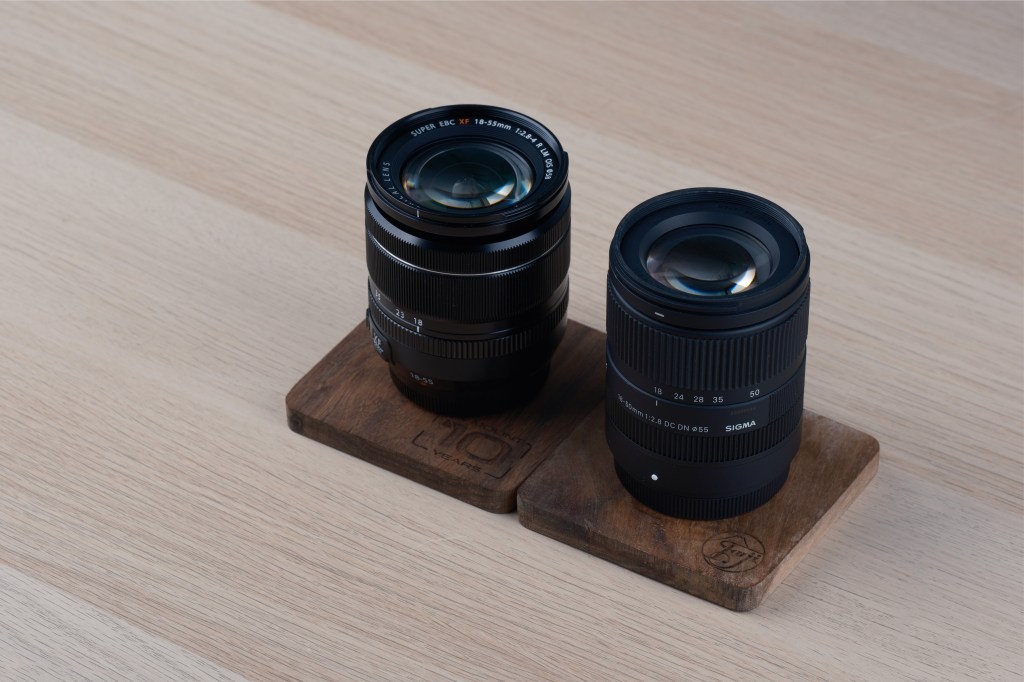
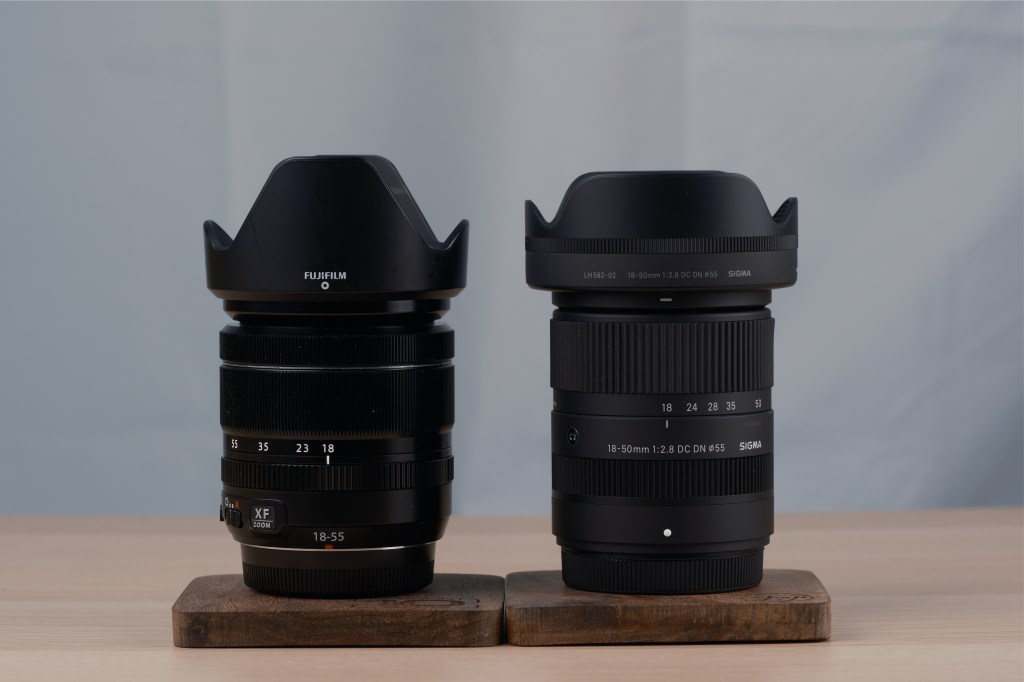
Physically, they are very close to each other with XF18-55mm being a tad bigger but you cannot tell the difference if you are not comparing them side by side.
XF18-55mm f2.8 – f4 and Sigma 18-50mm f2.8
Putting image quality and performance aside, if I were to choose between them, I will choose Sigma 18-50mm. The reason is simple: constant aperture. As I have an IBIS camera, I do not need an Optional Image Stabilizer lens.
Others
Unlike other third-party manufacturers, this lens does not come with a data-transfer port (i,e. USB-C) or docking station to update the firmware. It is simply downloading the lens firmware, transferring it to an SD card, and updating the firmware via the camera body. the same as how we do for Fuji lenses.
In general, if you want to use it for commercial works or shooting events, documentaries, etc, it is possible. The focal length is sufficient to cover most genres but I would like to suggest this lens to a specific group of photographers and that is travel photographers and budget photographers.
Travel photographers who want to travel lightweight (especially avoiding strain on your shoulder on long hours) or want to pack as compactly as possible but do not want to sacrifice too much on image quality. I think you can consider this lens for your next trip.
This lens also comes with a very attractive price point which I think is a good starter lens for the photographer who has a budget to work on.
Conclusion
Although this lens does not come with the widest possible focal length (like 16mm), this lens no doubt has great versatility which covers our most frequently used focal lengths. As a Fuji fanboy, I do miss the aperture ring. But let’s not forget that it does produce decent image quality, compact size, and reliable autofocus speed. And most importantly, it is priced very well for a constant aperture lens. What can I ask for? A better-built quality like the I series. I hope to see the X-mount variant someday.
Disclaimer: 1. All the shots taken here are shot by me. 2. Sigma 18-50mm f2.8 is running on firmware 0.99. At the time of this blog release, firmware 1.10 was released, but I have not had the chance to upgrade and test it. 3. Most of the shots are straight out of the camera with some shots edited via In-Camera Raw Processing or Capture One. 4. The opinions are based on my experience. If there is any mistake, please kindly drop me a message and I will gladly make the amendment. 5. I reserve ownership of these images, if you wish to use my images, please notify me.
If you like my works, please follow me on either one of the 2 Instagram accounts:
The year 2022 was another fruitful year for me. Of the 28 posts I have posted this year, 21 are reviews of camera gears and lenses. I also had a small achievement by getting 100k views on this blog this year (A big thank you, everyone!). It is challenging to juggle my job, photo shoots, and family time but I am glad I have made it and I enjoy the process.
Again, I would like to thank Carmen, Marketing Manager of Fujifilm Singapore, Cles Distribution of Tamron, Mr. Lawson from Sigma Marketing (Singapore), TTArtisan, Laowa, and FunLeader for giving me the opportunity to be able to hands-on with the gears and lenses, otherwise, this would not even happen.
I am happy to see more X-mount lenses released this year. Especially this year, Fuji has gained a lot of support from the 3rd party manufacturers and of course, I am referring to the autofocus lenses. While we have no idea what Fujifilm going to release next year but I hope to have an exciting one (I pray for X-Pro 4 and X100V successor arrival). And I also hope to see more autofocus lenses from 3rd party manufacturers to be released next year.
Okay, back to the topic. This is a little different from last year. I decided just to share what are my favorite photos taken this year (because it is hard to filter just 12 photos) and I also split them into 2 categories: “The street” & “The portrait”. Please enjoy.
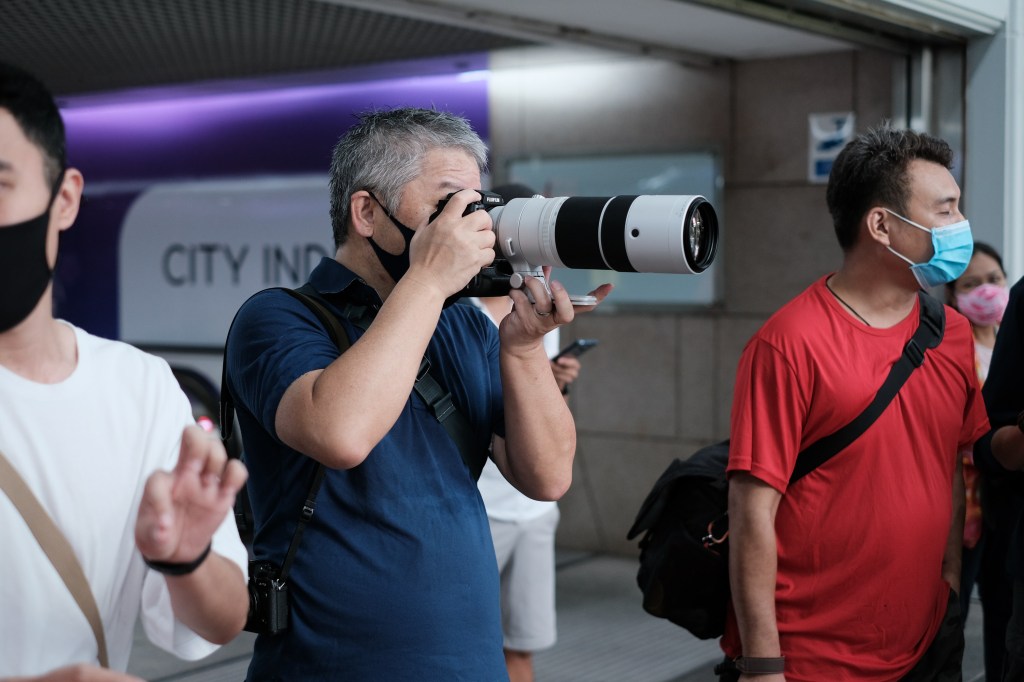
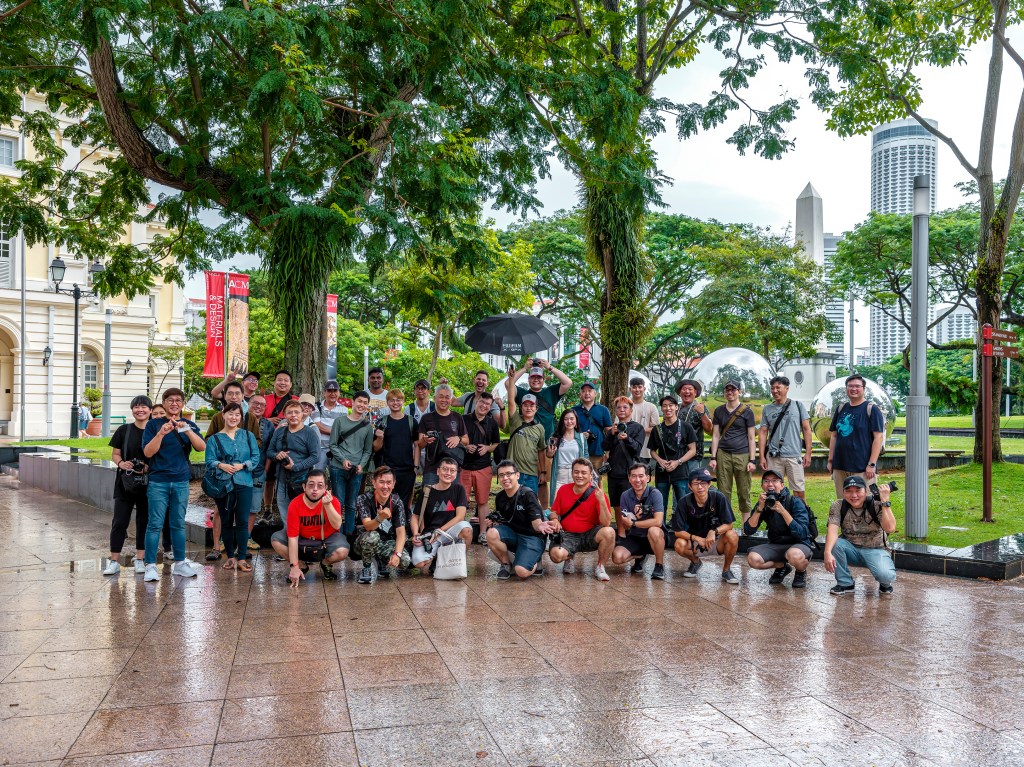
I have organized quite a few small groups of photo walk for the past 2 years but this is the first photo walk organized under the name of FujiFanBoys Facebook Group. I am excited because this is my first attempt to organize with Ivan Joshua Loh with such a huge group size together. In case you wonder, this is a whopping 40 pax group size.
Not only that, we have lens support from 5 amazing brands: Fujifilm, Sigma, Tamron, TTArtisan and Voigtländer. Really appreciate their kind support!
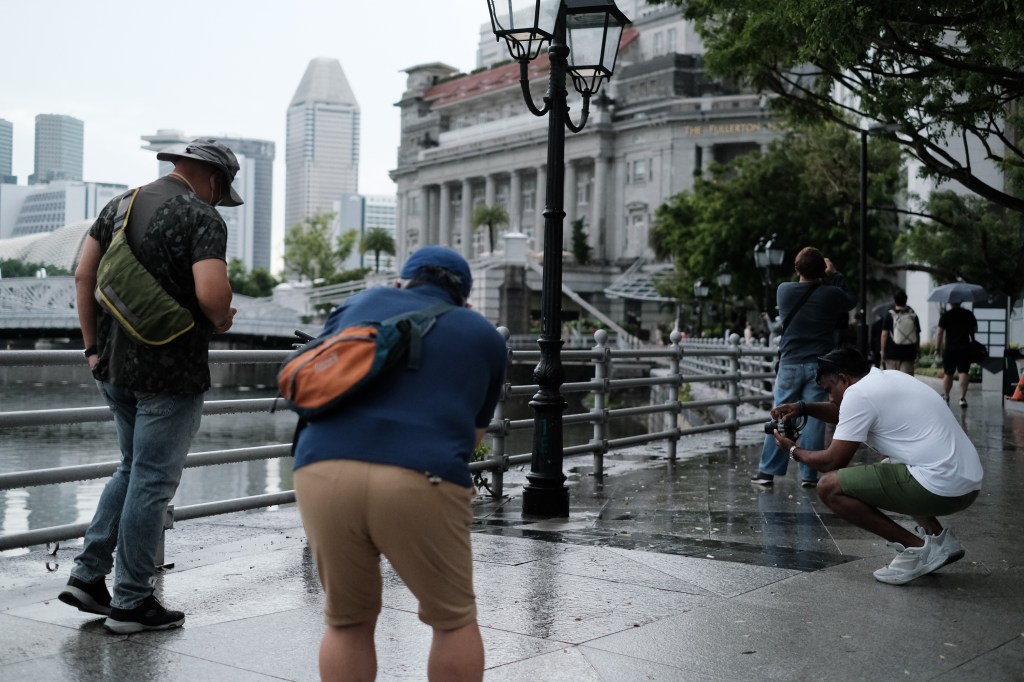
This first walk is not an easy one, to begin with, the weather decides to rain heavily in the morning. Instead of starting photo walking at 8:45am, we delay it an hour later. Now come to think of it, the rain actually gives us a good opportunity to mingle around with the group before the walk.
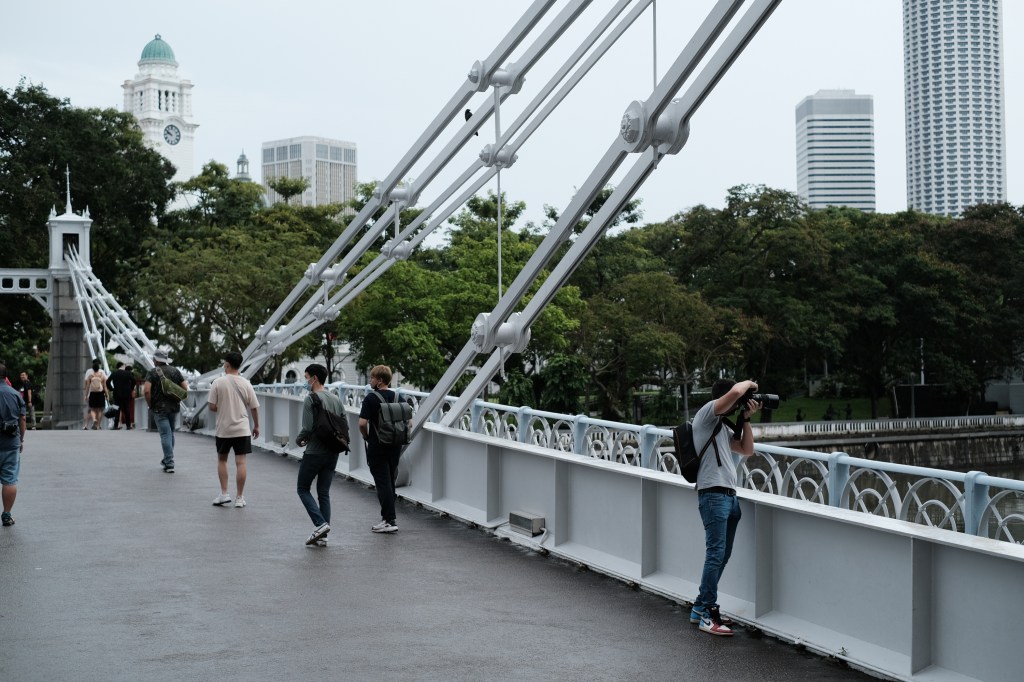
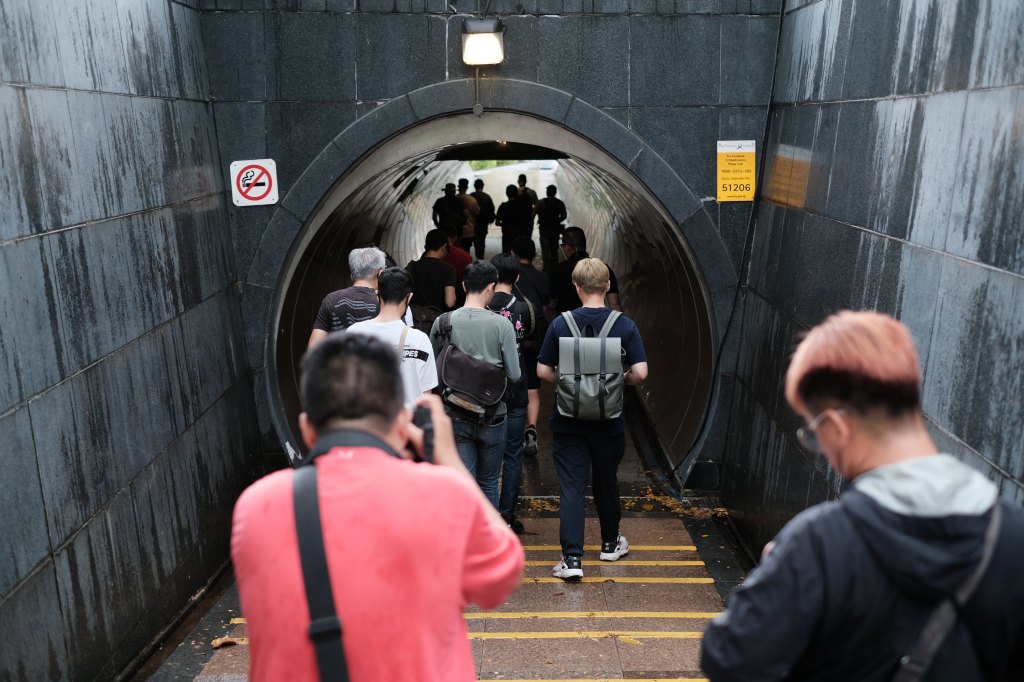
Morning coffee before the photo walkGathering at open space. Trying out the new X-H2S and XF150-600mm.Rain starts. Everyone taking cover while taking the opportunity to mingle and try out the new gears.Briefing commences…Have a can of beer before the photo walk starts.The walk.Hello to Otter from Zouk Otter FamilyThe photographers.
Despite the rainy morning, I am glad that the majority of the FujiFanBoys and FanGirls choose to turn up for the walk! Hope we will arrange another one soon!
Photo by Jere of Fujifilm.
Thank you to Sean for taking this portrait shot of me with the new X-H2S and XF18-120mm
Thank you for reading.
If you like my works, please follow me on either one of the 2 Instagram accounts:
Before I start with this experience sharing post, I would like to thank and appreciate Mr Lawson from Sigma Marketing (Singapore) for providing me with the loan of Sigma 56mm f1.4 Contemporary DC DN.
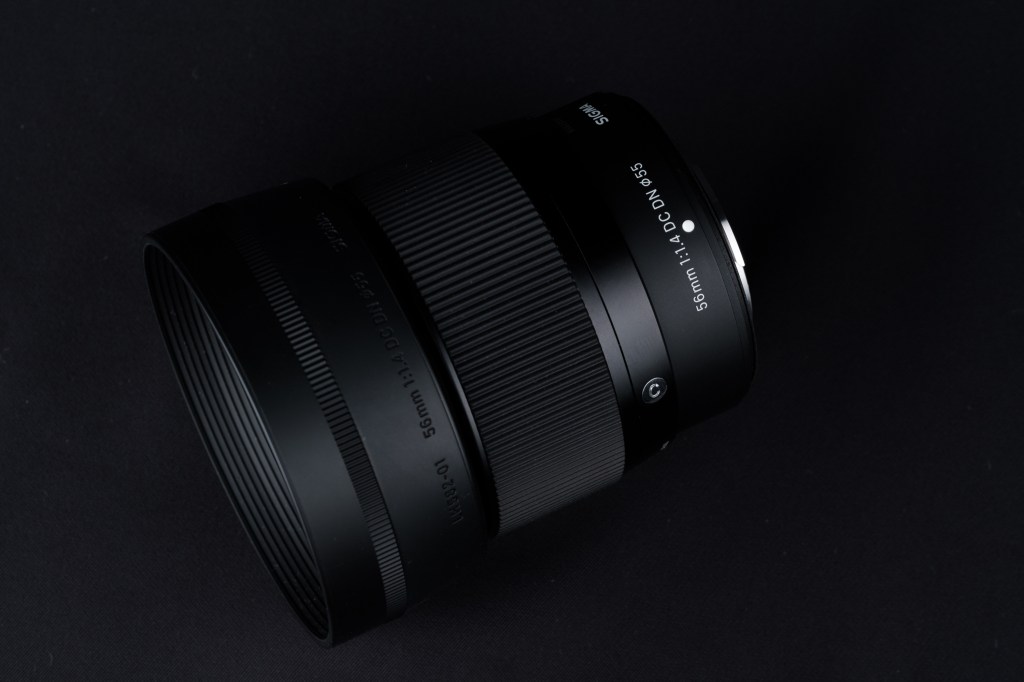
Sigma 56mm f1.4 Contemporary DC DNSigma 56mm f1.4 Contemporary DC DN
Intro
Fujifilm has never lacked of lens choices for portrait shooters to choose from. And there are even massive options available from the 3rd party manual lens manufacturers but not so much for autofocus lenses. I think this is the right time for Sigma to jump into the Fuji X-mount bandwagon with its trio lenses, especially the 56mm f1.4.
Sigma 56mm f1.4 Contemporary DC DNSigma 56mm f1.4 Contemporary DC DN with 2 XF 27mm f2.8 WR
56mm (85mm in 35mm format equivalent) is one of the popular focal lengths among portrait lovers. That’s because the mid-tele focal length gives good compression and shallow depth of field. But before going down further. I have to confess that I do not own the XF 56mm f1.2 or any 3rd party autofocus lenses of the same focal length. Hence, I am unable to make a good comparison between them. But what I can do is share my experience using this lens with the readers and hope the readers will have a good perspective of this lens.
Fuji X-T3 . Sigma 56 mm f1.4 @ 56mm . f4 . 1/80″ . ISO 400. Classic Chrome
I have reviewed the Sigma 16mm f1.4 and Sigma 30mm f1.4 and now the Sigma 56mm f1.4 Contemporary DC DN is on the table. This is the last piece of the trio prime lenses and let’s see how good the lens performance is.
Design & Build Quality
The lens built shared the same design elements as its brothers, giving us a low key minimalistic look. I get more enjoyment with the looks, especially the black labelled wordings on it. Similarly, this lens is also made of “Thermally Stable Composite” (TSC) polycarbonate material. Overall, it provides a very well-built lens body that is easy and lightweight to hold. Something to note, the lens does attract some fingerprints on the glossy material. Although it can be easily wiped off with a piece of cloth, it can be a little annoying and hard not to notice it.
Left: Fuji X-T3 . Sigma 56 mm f1.4 @ 56mm . f1.4 . 1/1100″ . ISO 160 . Classic Chrome Right: Fuji X-T3 . Sigma 56 mm f1.4 @ 56mm . f1.4 . 1/1800″ . ISO 160 . Classic Chrome
In my opinion, when I talked about the compact lens, a reasonably small filter thread size and weight are part of the elements. This lens comes with a 55mm filter thread and weighs only 280 grams. So I think this lens qualifies as a compact lens.
Left: Fuji X-T3 . Sigma 56 mm f1.4 @ 56mm . f1.4 . 1/5800″ . ISO 160 . Classic Chrome Right: Fuji X-T3 . Sigma 56 mm f1.4 @ 56mm . f1.4 . 1/5400″ . ISO 160 . Classic Chrome
Likewise, this lens is also equipped with dust and splash resistant sealing that helps to protect the lens from certain weather/environmental conditions. Last but not least, it does not come with an aperture ring either.
Image Quality
According to Sigma Marketing, each and every part of this lens was designed in 2018 (except the mount). Fast forward to 2022, how does the optical quality perform in real-world situations? If you read about how well the Sigma 30mm performed, then you can conceivably conclude that this is as good as that piece of glass or possibly even better. At wide open, the sharpness, details and contrast produced by this lens are comfortably good for my liking.
Fuji X-T3 . Sigma 56 mm f1.4 @ 56mm . f1.4 . 1/4000″ . ISO 320 . Classic Chrome
I do observe some mild vignetting when I shoot at f1.4 but I think that is acceptable. If vignetting is a problem, you can either stop down to lower aperture or remove it via post-processing. As for the chromatic aberration, I do not think I observe any or I barely notice it during my tests. I think Sigma engineers are really doing a great job in this department.
Left: Fuji X-T3 . Sigma 56 mm f1.4 @ 56mm . f8 . 1/640″ . ISO 160 . Classic Chrome Right: Fuji X-T3 . Sigma 56 mm f1.4 @ 56mm . f16 . 1/170″ . ISO 160 . Classic Chrome
For the sunny star result, the shot taken at f8 produces a softer and less rounded result. Contrastingly, the result looks sharper at f16 and more pronounced than that of f8.
Fuji X-T3 . Sigma 56 mm f1.4 @ 56mm . f1.4 . 1/17,000″ . ISO 320 . Classic Chrome
For a portrait lens, what a photographer wants from a portrait lens is bokeh. Who doesn’t love beautiful bokeh? This lens probably does not produce the best bokeh but rather a pretty decent and comfortable to the eyes. Although the bokeh ball is lemon-shaped like at wide open, it does not distract me from looking at the main subject.
Fuji X-T3 . Sigma 56 mm f1.4 @ 56mm . f8 . 1/125″ . ISO 160 . Post-edited Left: Fuji X-T3 . Sigma 56 mm f1.4 @ 56mm . f8 . 1/125″ . ISO 160 . Post-edited Right: Fuji X-T3 . Sigma 56 mm f1.4 @ 56mm . f8 . 1/125″ . ISO 160 . Post-edited
Focusing
Thanks to the stepping motor, the focusing experience is a great one. It is silent, fast and *accurate. I cannot hear a single motor sound produced by the stepping motor while I am focusing. Apparently, my shutter is louder.
Fuji X-E3 . Sigma 56 mm f1.4 @ 56mm . f1.4 . 1/11,000″ . ISO 400 . Classic ChromeLeft: Fuji X-T3 . Sigma 56 mm f1.4 @ 56mm . f1.4 . 1/110″ . ISO 160 . Classic Chrome Right: Fuji X-T3 . Sigma 56 mm f1.4 @ 56mm . f1.4 . 1/350″ . ISO 320 . Classic Chrome
Unlike its brothers, this lens does not inherit the focusing accuracy issue. On the flip side, I do encounter some rare auto-focus hunting at times. It does not matter whether I used it during the day or night, indoor or outdoor. While I tried to replicate the focus hunting issue right from the moment I experienced it, I failed. The lens somehow just does not has this hurdle anymore.
Fuji X-T3 . Sigma 56 mm f1.4 @ 56mm . f1.4 . 1/1800″ . ISO 320 . Classic ChromeFuji X-E3 . Sigma 56 mm f1.4 @ 56mm . f1.4 . 1/5000″ . ISO 400 . Classic Chrome
But do not worry about it. As I understand from Sigma Marketing, their team is constantly updating their lenses to improve the focus quality and accuracy.
Minimum Focus Distance (MFD)
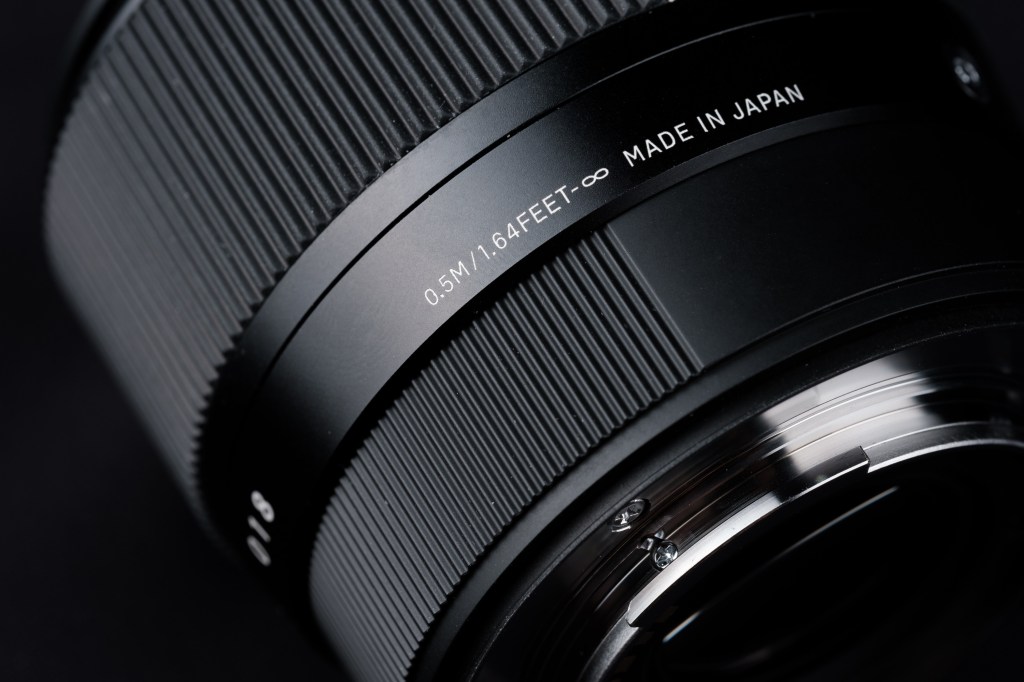
This lens’ MFD is at 50cm. For a glimpse comparison, XF56mm f1.2 is 70cm, XF50mm f2 is 39cm and the XF50mm f1 is also 70cm.
While it is not as close as the XF50mm f2, it is definitely better than the other 2 Fuji lenses have to offer. Does MFD matter? In my case, the answer is yes. It allows me to have a shallower depth of field between the subject and the background.
Left: Fuji X-E3 . Sigma 56 mm f1.4 @ 56mm . f1.4 . 1/26,000″ . ISO 400 . Classic Chrome Right: Fuji X-E3 . Sigma 56 mm f1.4 @ 56mm . f1.4 . 1/23,000″ . ISO 400 . Classic Chrome
Certain lenses have some level of softness when you shoot at wide-open and at MFD. Fortunately, this lens is otherwise, it is surprisingly sharp & usable. I actually like how it renders and it does not have very harsh bokeh results.
Price Point
Okay, this is “straightforward” and also “challenging” at the same time.
Let’s talk about “straightforward” first, if you are on a budget and compare it with the XF50mm f2 (*SRP SGD749, USD449). I think the Sigma 56mm (SRP SGD688, USD479) is pretty worth it. Hear me out. While you sacrifice the weather resistance that Fuji 50mm f2 offers, you have one full stop of light at your disposal. It is always an advantage when you have that extra stop of light, it will come in handy when you need it. More light is a higher priority in my case.
Fuji X-T3 . Sigma 56 mm f1.4 @ 56mm . f8 . 1/300″ . ISO 320 . Classic ChromeLeft: Fuji X-T3 . Sigma 56 mm f1.4 @ 56mm . f1.4 . 1/125″ . ISO 500 . Classic Chrome Right: Fuji X-T3 . Sigma 56 mm f1.4 @ 56mm . f1.4 . 1/80″ . ISO 160 . Classic Chrome
Here comes the challenging part, Sigma is actually priced right between another 2 third party manufacturers, Viltrox and Tokina. I believe you know which one costs higher and which one is more pocket friendly. I cannot speak on behalf of these 2 manufacturers about their portrait lenses because I did not try them out before. What I searched online is that they shared some similarities (with a little 10% difference) like weight, filter size and MFD. I think it is best for you to visit your local stores to have some hands-on experience with these 3 lenses.
Fuji X-T3 . Sigma 56 mm f1.4 @ 56mm . f1.4 . 1/680″ . ISO 320 . Post-editedLeft: Fuji X-E3 . Sigma 56 mm f1.4 @ 56mm . f2 . 1/2400″ . ISO 200 . Classic Chrome Right: Fuji X-E3 . Sigma 56 mm f1.4 @ 56mm . f1.4 . 1/9000″ . ISO 400 . Classic Chrome
*SRP – Suggested Retail Price
Conclusion
This is a decent portrait lens for its price and compactness. In these few weeks of hands-on, I enjoy shooting with this lens a lot. I mean, I actually used it for street photography and cityscape besides shooting portraits. It gives me a new perspective and sees things differently from my usual 23mm and 35mm focal length.
Left: Fuji X-E3 . Sigma 56 mm f1.4 @ 56mm . f5 . 1/1800″ . ISO 400 . Post-edited Right: Fuji X-E3 . Sigma 56 mm f1.4 @ 56mm . f7.1 . 1/1000″ . ISO 200 . Classic Chrome
The optical quality does not tell this lens is actually designed in 2018 and the results are truly usable and sharp and contrast at wide open. In short, Sigma delivers great results in its “Contemporary” series. I am actually excited and looking forward to that one day when Sigma updates its “Contemporary” lenses and distinguishes itself among the third party manufacturers.
Left: Fuji X-T3 . Sigma 56 mm f1.4 @ 56mm . f1.4 . 1/300″ . ISO 160 . Post-edited Right: Fuji X-T3 . Sigma 56 mm f1.4 @ 56mm . f1.4 . 1/480″ . ISO 320 . Classic Chrome
Who is this for?
For photographers who are just picking up and want a portrait lens with a modest budget, this might be a wise choice for you. This lens gives you an extra stop of light as compared to XF50mm f2 and is more economical than XF56mm f1.2. It really strikes a good balance in terms of price and performance while minimising the compromise that it has.
Fuji X-T3 . Sigma 56 mm f1.4 @ 56mm . f1.4 . 1/125″ . ISO 320 . post-edited
Fuji X-T3 . Sigma 56 mm f1.4 @ 56mm . f1.4 . 1/220″ . ISO 320 . Post-edited
For street photographers who love to shoot at a distance away from the subject, this is also a good choice but, of course, it does not have as much flexibility as the Sigma 30mm has.
Left: Fuji X-T3 . Sigma 56 mm f1.4 @ 56mm . f1.4 . 1/80″ . ISO 640 . Post-edited Right: Fuji X-T3 . Sigma 56 mm f1.4 @ 56mm . f1.4 . 1/125″ . ISO 2000 . Post-edited
Thank you for reading.
Disclaimer: 1. The lens is a loan unit from Mr. Lawson from Sigma Marketing (Singapore). By the time this review was online, the lens had returned back to Sigma Marketing (Singapore). 2. The lens firmware that I am using is version 1.00. 3. Some of the shots are straight out of the camera while others are edited via In-Camera Raw Processing and Adobe Lightroom Classic & Capture One. 4. The opinions are based on my experience. If there is any mistake, please kindly drop me a message and I will gladly make the amendment. 5. All the shots taken here are shot by me. I reserve ownership of these images, if you wish to use my images, please notify me.
If you like my works, please follow me on either one of the 2 Instagram accounts:
First and foremost, I would like to thank and appreciate Mr Lawson from Sigma Marketing (Singapore) for loaning me the Sigma 16mm f1.4 Contemporary DC DN lens for making this review possible.
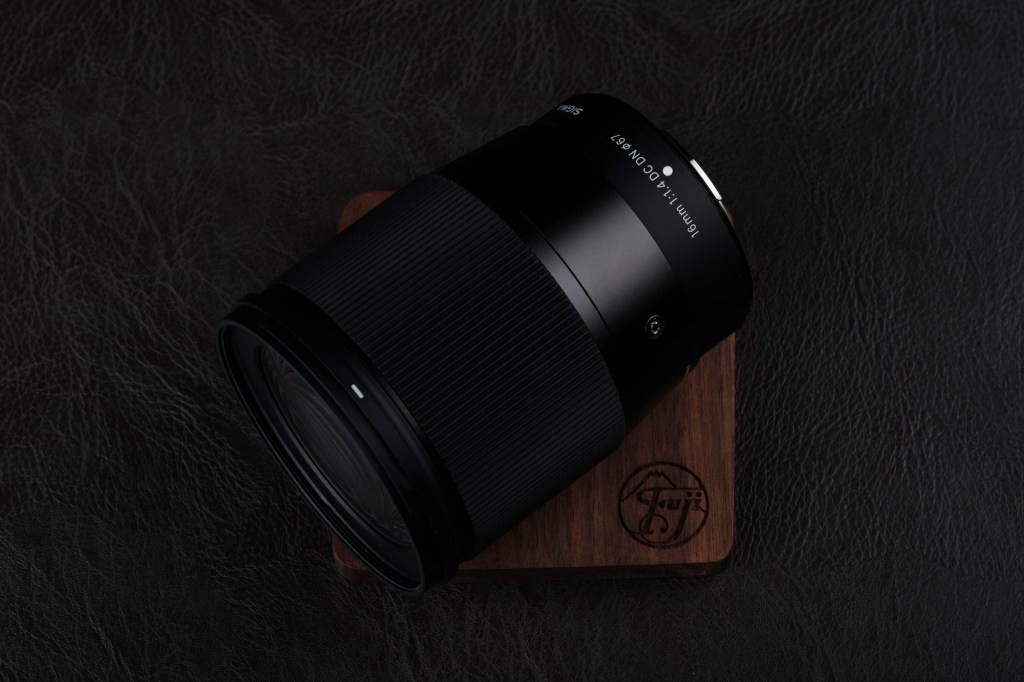
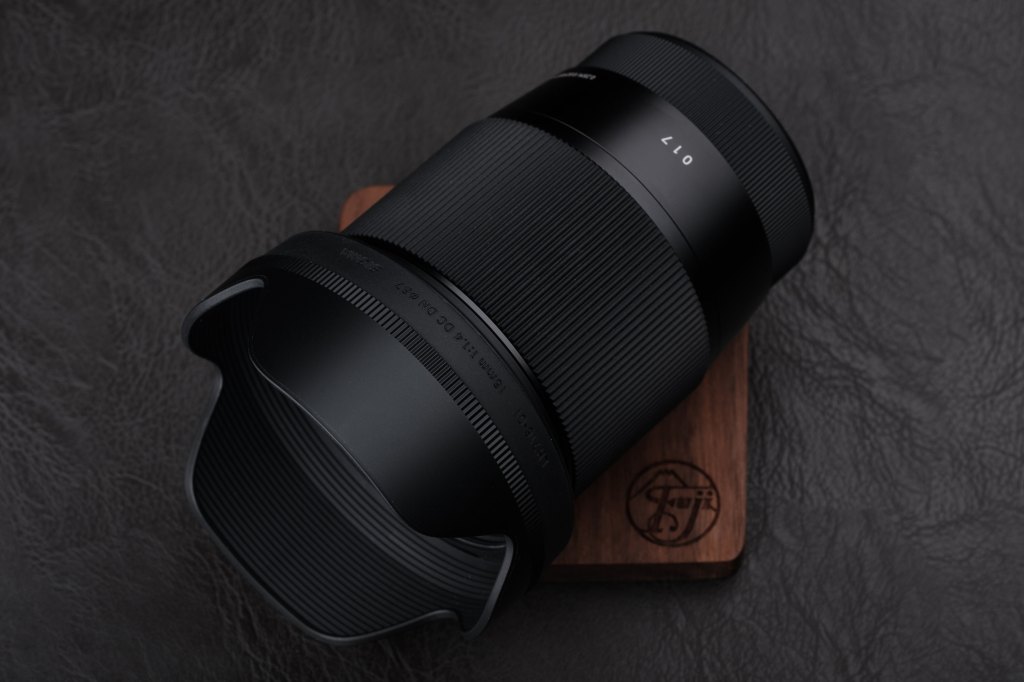
Sigma 16mm f1.4 Contemporary DC DN
Intro
Similar to Sigma 30mm f1.4 Contemporary DC DN, I refer to Sigma 16mm f1.4 Contemporary DC DN as “Sigma 16mm f1.4” in short. Unlike the Sigma 30mm f1.4, it was announced back in October 2017 but was only available for EF-M, E-mount, L-mount and Micro Four Thirds back then. Now it is available in X-mount too.
Sigma 16mm f1.4 Contemporary DC DNSigma 16mm f1.4 Contemporary DC DN
Being a 24mm full-frame equivalent ultra-wide lens, the first thing that I can’t help noticing how huge the lens is. It is almost identical to the size of the Fuji XF16mm f1.4 and it is merely taller. Speaking of comparison, I will not compare both lenses directly as I believe every lens has its own reasons to be here and hence giving it a fair chance to shine.
Sigma 16mm f1.4 Contemporary DC DN
Price Point
I decided to shift this section to the front because Sigma 16mm f1.4 comes at a very interesting and competitive price point. In Singapore, it is priced at SGD648/USD449 (*SRP). It is just $50 more than the XF 16mm f2.8 (SGD599/USD399 SRP) and it is far cheaper than XF 16mm f1.4 (SGD1599/USD999 SRP). With such a competitive price, are you tempted to get Sigma instead of Fuji?
At this price point, lets me share with you what are the things you will be getting from this lens and what are the thing you will miss.
*SRP – Suggested Retail Price
Design & Build Quality
Sigma 16mm f1.4 has the same built element and design language as its brothers. It is a low profile lens that does not shout out loud, especially on the front glass. It is minimalistic on its own by labelling the wordings in black.
Although the body of the lens is made of “Thermally Stable Composite” (TSC) polycarbonate material, it feels well-constructed and comfortable to hold. But it does attract some fingerprints on the glossy material of the lens. Even so, it can be removed easily with a piece of cloth.
This huge lens weighs 405 grams and it is the heaviest one among the trio of Sigma lenses. I think there is quite a huge amount of heavy glass elements inside this lens, which explains the weighty weight. For readers who are looking to equip the lens with filters, it comes with a filter size of 67mm. It also comes with dust and splash resistant sealing that helps to protect the lens from certain conditions.
Similarly to the Sigma 30mm f1.4, it does not have an aperture ring too. So you have to control your aperture via the front dial of your camera. It’s a very similar approach to what Fujifilm has for XC lenses.
Image Quality
At f1.4, the image is usable. It retains the sharpness, contrast and details of the image very well. But for some shots especially shooting at infinity, the results tend to be soft at wide-open.
Although some vignetting can be observed, this can be easily resolved in post-processing or shot at a smaller aperture to reduce it. In my opinion, this can be forgiving and unavoidable because it is an ultra-wide lens after all.
There is also some slight chromatic aberration observed in some of my shots, but it is still within my acceptance level. Again, it can be removed easily with post-processing.
On the subject of the sunny star result, I prefer the shot taken at f16 as the “star” looks sharper than the one at f8. As for the lens flare, it did control very well too.
One thing to note, I never expect how good the control of the lens distortion for this ultra-wide lens. Probably thanks to the camera auto-correction? But nonetheless, the output is good.
Focusing
This lens is silent and fast. This is something that I have expected after using Sigma 30mm f1.4 as I believe they are using the same stepping motor. The sound of the focusing experience that I have is close to complete silence. Please bear in mind that this lens has lots of heavy glass inside it and yet it can achieve something like this is totally remarkable.
Regarding the focusing accuracy, unfortunately, it also inherits the same issue as the Sigma 30mm f1.4 as well. Similar off-focused results when I shoot with the little green box lit up but it hardly happens. But not too worry about it, understand from Sigma that they are constantly improving their lenses’ focusing quality and accuracy via updates.
The MFD of this lens is 25cm. By comparison, the XF16mm F1.4 is 15cm. Does it really matter? Not really matter as the general purpose of this lens is for landscape or similar genres.
But it does matter if the photographer could love to use the lens for other creative purposes. Because the closer the MFD you have, the more possibilities you can create with.
Sigma 16mm f1.4 does have its shortfall but it strikes a good balance between price and overall experience. For a lens optic design that has been around for 5 years, the image renders very remarkably sharp, especially at wide open. I have to appraise that Sigma did not compromise on the image quality and I think Sigma did the right thing here as I believe this is more important than anything else for every photographer.
Overall, I can accept what this lens has to offer. Likewise, how is it compared to XF16mm f1.4? All I can say is that both lenses are good at their price points and there are reasons to be at their price points. They supply different demands to different groups of photographers. In my opinion, there is no end to making comparisons between lenses.
Who is this for?
This lens is suitable for photographers who are just starting to learn photography or tipping their toes in the world of prime lenses but with a limited budget on hand or wish to have their money well spent. But who are these photographers?
Photographers who are landscape, environmental and architecture lovers, you may consider getting this lens in your arsenal. If you do not mind about its build quality, etc, the price of this lens can actually save you some money and maybe you can use that money to invest in other lenses or accessories.
For street photographers, this ultra-wide lens is harder to isolate your subject unless you get closer to it. If you know what you intend to do with this lens, otherwise I will not recommend you to use this lens.
To answer my question in the title, it is indeed a good alternative to XF16mm f1.4.
Thank you for reading.
Disclaimer: 1. The lens is a loan unit from Mr. Lawson from Sigma Marketing (Singapore). By the time this review is online, the lens had returned back to Sigma Marketing (Singapore). 2. The lens firmware that I am using is version 1.00. 3. Some of the shots are straight out of the camera while others are edited via In-Camera Raw Processing and Adobe Lightroom Classic & Capture One. 4. The opinions are based on my experience. If there is any mistake, please kindly drop me a message and I will gladly make the amendment. 5. All the shots taken here are shot by me. I reserve ownership of these images, if you wish to use my images, please notify me.
If you like my works, please follow me on either one of the 2 Instagram accounts:
























































































































































































































 Alwin Kok